
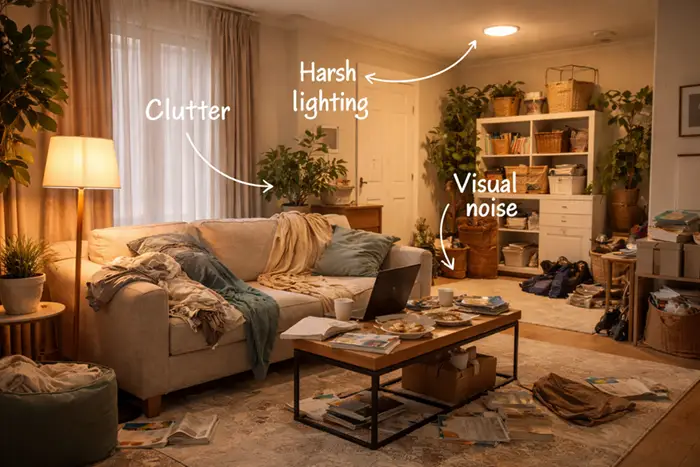
There was a stretch where I couldn’t figure out why I felt drained at home, even on days when I hadn’t done much at all. I wasn’t rushing, I wasn’t overwhelmed with tasks, and yet the space itself felt heavy. Sitting on the couch didn’t recharge me. Being at my desk didn’t feel grounding. It took a while to realize the problem wasn’t my energy — it was the environment quietly pulling from it.
Visual noise plays a bigger role than we give it credit for. Open shelves packed with half-used items, cables that never quite disappear, stacks that don’t belong anywhere specific — none of it screams “stress,” but all of it whispers. Your eyes are constantly scanning, sorting, deciding. Even when you’re resting, your brain is still working, trying to make sense of the space around you.
Lighting was another piece I underestimated. Harsh overhead lights made evenings feel sterile and exposed, like the day never really ended. Shadows landed in odd places, corners felt unfinished, and nothing invited me to settle in. Once I started using softer, warmer light — lamps placed lower, light bouncing off walls instead of blasting straight down — the room instantly felt quieter. The same space, just easier to exist in.
Then there’s flow — how you move through a room without thinking about it. When furniture interrupts natural paths, when storage is inconvenient, when you have to sidestep or reach awkwardly just to live your life, it adds friction. Not enough to notice consciously, but enough to wear you down over time. When I adjusted a few placements and gave everyday items a real home, movement became automatic again.
Textures mattered more than I expected too. Hard surfaces everywhere reflected sound and light in ways that kept the room feeling alert instead of restful. Adding soft elements — curtains, fabric bins, a rug underfoot — absorbed some of that edge. The room didn’t change dramatically, but it stopped asking so much from me.
I didn’t expect something this simple to make my home feel calmer.
📦 Buy on Amazon USA
🕯️ Final Thoughts
A home doesn’t have to be messy to be exhausting. Sometimes it’s just visually loud, poorly lit, or slightly out of sync with how you actually live. Those small mismatches add up quietly, especially when you’re spending a lot of time indoors.
What surprised me most was how gentle the fixes were. No big renovations. No dramatic overhauls. Just small adjustments that reduced visual strain and made the space feel more cooperative, like it was finally on my side instead of asking me to manage it.
Comfort at home often comes from subtraction rather than addition. Fewer distractions, softer light, smoother flow. When a space stops demanding your attention, rest becomes possible again — even when you’re doing absolutely nothing.