
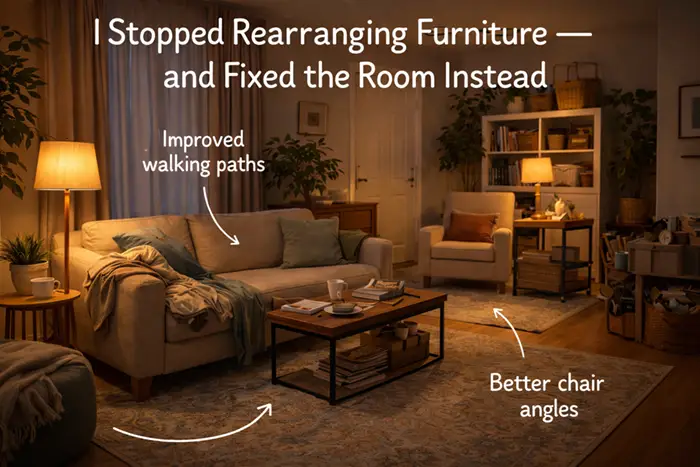
For a long time, I thought the solution to a room that felt “off” was to keep moving things around. Couch here. Chair there. Desk angled differently. Every few weeks I’d try again, convinced I just hadn’t found the right layout yet. But no matter how much I rearranged, the room still felt awkward — like it was working against me instead of with me.
What finally clicked was that the problem wasn’t where things were placed, but how I was moving through them. Walking paths were tight in some spots and oddly wide in others. I was constantly stepping around furniture instead of flowing past it. Once I paid attention to how I entered the room, where I naturally walked, and where I paused, the issues became obvious.
Chair angles were another quiet culprit. A chair pointed slightly away from where I actually sit or look might not seem like a big deal, but it creates subtle resistance. I noticed myself never fully settling into certain spots — not because they were uncomfortable, but because they were misaligned. Rotating a chair just a few degrees toward the room changed how welcoming it felt, without moving it anywhere else.
Then there were the dead zones. Corners that collected nothing useful. Spaces between furniture that didn’t serve a purpose. These weren’t empty in a peaceful way — they were just forgotten. Instead of leaving them unresolved, I gave them small, intentional roles. A slim side table where I naturally reach. A rolling cart where clutter used to drift. Suddenly, those dead zones became helpful instead of distracting.
Rugs helped more than I expected too. Not as decoration, but as anchors. They defined where movement stopped and where rest began. A rug under a chair made it feel grounded. One under a table clarified its purpose. The room didn’t get fuller — it got clearer.
I didn’t expect something this simple to make my home feel calmer.
📦 Buy on Amazon USA
🕯️ Final Thoughts
A room doesn’t always need new furniture — it often needs better logic. When walking paths are clear and seating feels intentional, your body relaxes without you realizing why. You stop adjusting, sidestepping, and compensating.
What surprised me was how little I actually moved things. Most pieces stayed where they were. I just paid attention to how I lived in the space instead of how it looked on first glance. That shift made everything feel more cooperative.
Fixing a room doesn’t have to be loud or expensive. Sometimes it’s about noticing the friction, smoothing it out, and letting the space finally support the way you move through your day.