For a long time, I thought my focus problem was mental. I’d sit down with good intentions, clear tasks, even a quiet room — and still feel restless after a short stretch. I blamed motivation, discipline, maybe even the work itself. It never occurred to me that my body was quietly asking for help the entire time.
The first thing I noticed was how often I shifted in my chair. Not dramatically — just small adjustments. Feet tucking back, legs crossing and uncrossing, shoulders creeping upward. None of it felt uncomfortable enough to fix, but all of it pulled my attention away in tiny increments. My focus wasn’t breaking all at once — it was leaking.
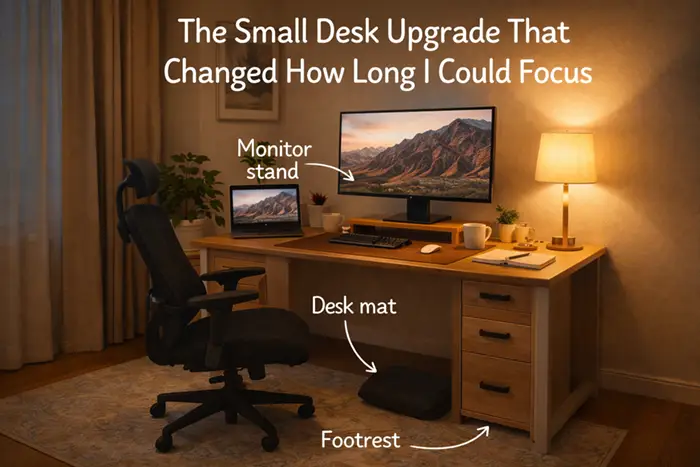
The change came from something almost embarrassingly simple: supporting my body better where it was already struggling. A footrest gave my legs a place to settle instead of hovering. A desk mat softened the space under my hands, reducing that subtle tension I didn’t realize I was holding. The desk didn’t look different — it just felt easier to stay in.
Once that friction was gone, time behaved differently. I wasn’t checking the clock as often. I wasn’t standing up just to reset myself. My thoughts stayed with the work longer because my body stopped asking for constant adjustments. Focus stopped feeling like effort and started feeling like a natural result of being comfortable.
What surprised me most was how quiet the improvement was. No productivity hacks. No timers. Just fewer physical interruptions pulling me out of the moment. The desk became a place I could stay, not escape from.
I didn’t expect something this simple to make my home feel calmer.
📦 Buy on Amazon USA
Supportive ergonomic desk chair
🕯️ Final Thoughts
Focus isn’t always about willpower — often it’s about how much resistance your body is quietly pushing against. When your posture is unsupported or your setup asks for constant micro-adjustments, attention gets scattered before you even notice it happening.
What worked for me was addressing the physical layer first. Giving my body fewer reasons to interrupt the task at hand made mental clarity easier to reach and easier to keep. The work didn’t change — the experience of doing it did.
Sometimes the most effective desk upgrades aren’t the ones that promise performance, but the ones that make staying put feel natural. When your body settles, your mind often follows.