For a long time, I was convinced my apartment was just small. I’d walk in and feel slightly boxed in, even though nothing was technically wrong. The square footage hadn’t changed. The furniture fit. And yet the space felt tighter than it should have, like it was closing in instead of opening up.
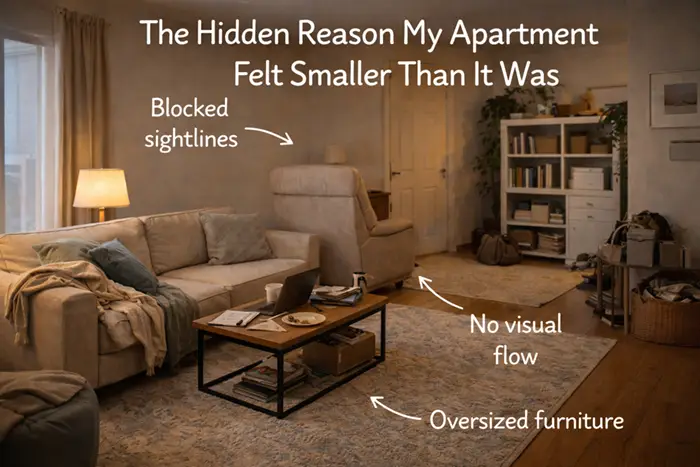
What I eventually noticed was how quickly my eyes ran into obstacles. Tall shelves cut sightlines in half. Furniture sat directly in the path of doorways. Even when there was enough room to walk, the space looked interrupted. My eyes couldn’t travel far before hitting a visual wall, and that made the room feel shorter and narrower than it really was.
Oversized furniture played a bigger role than I realized too. A deep couch, a bulky chair, storage pieces that hugged the floor — they all anchored the room visually, but in a heavy way. They pulled attention downward and inward. Even when the room was tidy, it felt dense, like everything was fighting for the same slice of space.
The shift came when I focused on visual flow instead of layout. Lower-profile furniture opened up sightlines instantly. Slim shelving let the eye move through instead of stopping it. Wall hooks lifted everyday items off the floor, clearing visual clutter without removing function. The room didn’t lose anything — it gained breathing room.
Once those blocks were gone, the apartment started feeling more expansive without actually getting bigger. Light traveled farther. Corners felt reachable again. Even movement felt easier, like the space was cooperating instead of resisting.
I didn’t expect something this simple to make my home feel calmer.
📦 Buy on Amazon USA
🕯️ Final Thoughts
A space can feel small even when it isn’t — especially when sightlines are broken and furniture overwhelms the eye. What tires us isn’t the size itself, but how quickly the room asks us to stop looking.
What worked for me wasn’t removing everything, but choosing pieces that allowed the space to flow visually. When the eye can move freely, the body relaxes. The room feels less compressed, even if nothing structural changes.
Sometimes the most spacious feeling comes from clearing what blocks the view, not adding more room. When a space finally opens up visually, it becomes easier to live in — and easier to rest inside.