
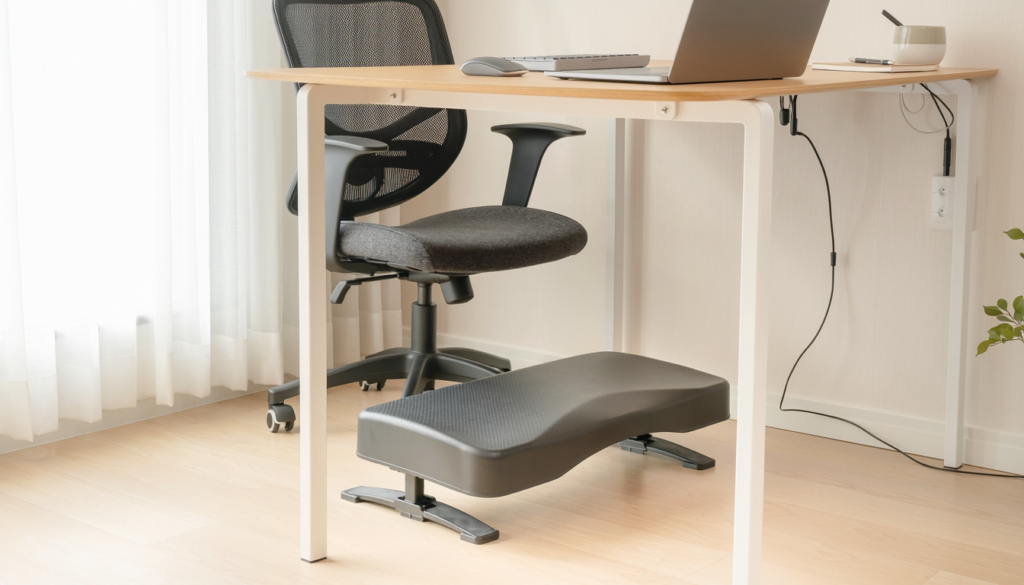
Best Under-Desk Footrest
Disclosure: As an Amazon Associate, My Indoor Space may earn from qualifying purchases made through links in this guide, at no extra cost to you.
An under-desk footrest is useful when the chair is set high enough for the desk but your feet no longer rest comfortably on the floor. The right model supports different positions without sliding away or crowding the limited space around chair legs.
Quick verdict
For most home offices, choose a height-adjustable footrest with a tilting or rocking platform, nonslip feet, a grippy surface, and enough width to change foot position. A firm platform offers more consistent support than a soft cushion, while a cushion is easier to move and lounge with.
Who it is for—and who should skip it
A footrest suits shorter users at fixed-height desks, anyone whose feet dangle after raising the chair to keyboard height, and people who like to change lower-leg position while working.
Skip it as a substitute for addressing a chair, desk, or workstation that is fundamentally the wrong size. Persistent pain, numbness, swelling, or circulation concerns deserve advice from an appropriate health professional.
Compare the main types
| Type | Best for | Main trade-off |
|---|---|---|
| Fixed platform | Simple dependable support | Limited fit adjustment |
| Height-adjustable platform | Precise workstation setup | Larger and more expensive |
| Rocking footrest | Frequent position changes | May move more than some users like |
| Foam cushion | Soft support and casual use | Compresses and offers less stable height |
| Foot hammock | Travel and lightweight desks | Requires compatible attachment points |
Best value: tilting nonslip platform
A basic platform that tilts under foot pressure offers the best value. It supports the feet while allowing ankle movement and does not require bending down to change angle settings.
Look for a textured top that works with socks or shoes and a base that grips your floor type. Some hard plastic feet slide on smooth flooring unless a mat is added.
Upgrade worth it: adjustable height and angle
Height adjustment is worth paying for when several people use the desk or when the chair must sit much higher than the floor. Tool-free adjustment makes it more likely that the setting will actually be changed.
A large platform provides room to move, but measure the desk opening first. The footrest must fit between legs, drawers, computer towers, and chair wheels without becoming a trip point.
Set the chair before the footrest
Adjust the chair so the keyboard and pointing device can be used with relaxed shoulders and supported arms. Then use the footrest to meet the feet rather than lowering the chair until the desk feels too high.
The thighs should feel supported without hard pressure behind the knees. A footrest can help fill the height gap, but the entire workstation needs to work together.
Firm platform vs soft cushion
A firm platform creates a predictable height and angle. It is easier to use with office shoes and holds its shape through long sessions. A rocking version encourages small position changes.
A foam cushion feels warmer and can be flipped for gentle rocking, but its usable height changes as it compresses. Choose a washable cover and dense foam that returns to shape.
Stability and floor protection
Rubber feet or a full nonslip base keep the footrest from creeping forward. Confirm that the base material will not mark wood, vinyl, or carpet.
Rocking models need clear space so they do not strike a wall, power bar, or chair caster. Keep cables away from every moving edge.
Movement features
Some footrests add rollers, massage bumps, or separate moving bars. These can make short breaks pleasant, but they should not create sharp pressure or force one repeated motion.
A simple tilting platform provides enough movement for many users and is easier to clean than mechanisms with narrow grooves.
Cleaning and durability
Hard platforms wipe clean and handle outdoor footwear. Fabric cushions collect dust and need a removable washable cover. Inspect seams, zippers, hinges, and height locks regularly.
Check the load guidance if you tend to press down firmly or stand on the product. Most footrests are not steps and must never be used as one.
Common buying mistakes
- Buying before measuring under-desk width and depth.
- Choosing a fixed height that is too low to help.
- Ignoring how easily it slides on the floor.
- Placing it where chair wheels catch the edge.
- Expecting a footrest to correct an unsuitable desk or chair by itself.
- Using it as a step stool.
Frequently asked questions
How high should a footrest be?
High enough to support the feet after the chair is adjusted for the desk, without creating uncomfortable pressure behind the knees. Adjustable models handle more body and desk combinations.
Is a rocking footrest better?
It is useful for people who enjoy small position changes. Someone who wants firm stationary support may prefer a locking or fixed platform.
Are foam footrests supportive?
Dense foam can feel comfortable, but it compresses more than a hard platform. Check the real compressed height and return policy.
Can a footrest help at a standing desk?
A low bar or sturdy product specifically designed for standing use can support position changes. Do not stand on a seated footrest unless it is rated for that purpose.
Final winner
The best under-desk footrest for most home offices is a wide, height-adjustable platform with free tilt, a nonslip textured surface, and a base that stays put. It supports a properly adjusted chair while leaving enough freedom to change position through the day.
Complete the workspace with our small-desk monitor arm guide and our guide to the under-desk heated foot pad.