
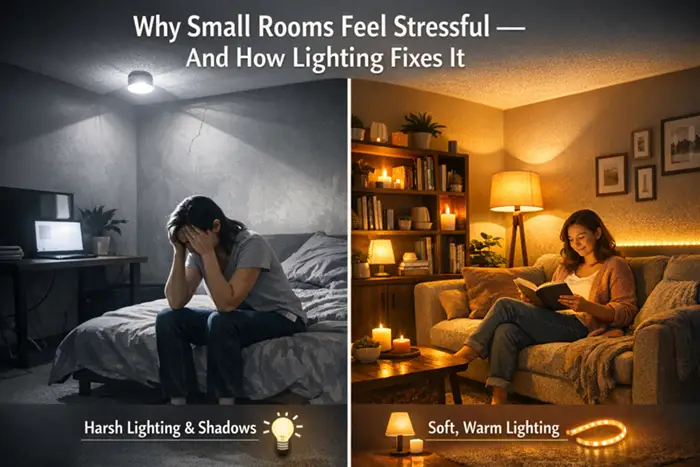
For a long time, I couldn’t quite explain why certain rooms made me feel tense the moment I walked in. Nothing was wrong exactly — the space was clean, organized, even minimal — but I always felt a little on edge, like my shoulders were permanently raised without me noticing. It took me longer than I’d like to admit to realize it wasn’t the size of the room doing this. It was the lighting.
Small rooms amplify everything. Shadows feel heavier. Harsh overhead lights bounce straight back into your eyes. Corners disappear into darkness while the center of the room feels exposed and flat at the same time. Your eyes are constantly adjusting, scanning, compensating — and your nervous system reads that as low-level stress. You don’t consciously think this room is overwhelming, but your body does.
I noticed it most in the evenings. The same room that felt tolerable during the day suddenly felt tight and restless once the sun went down. One ceiling light, one temperature, one direction — it left nowhere for my eyes to rest. The space felt smaller than it actually was, like it was pressing inward instead of opening up.
The shift happened slowly, almost accidentally. I added a small table lamp with a warm bulb, not even thinking much about it. Then another light near the floor. Later, a soft strip of indirect light behind a shelf. Nothing dramatic. But the room changed. Shadows softened. The walls felt farther away. My eyes stopped darting around, searching for balance. The space finally felt like it was holding me instead of demanding attention.
What surprised me most was how physical the change felt. My breathing slowed. My shoulders dropped. I started lingering in the room instead of passing through it. Lighting didn’t just change how the room looked — it changed how long I wanted to stay there, and how calm I felt while I did.
🛋️ Human line:
I didn’t expect something this simple to make my home feel calmer.
Good lighting in a small room isn’t about brightness — it’s about layers. Soft light at eye level, gentle glow near the floor, warm tones that tell your brain it’s safe to relax. When light comes from different directions, the room stops feeling boxed in. It gains depth, even if the square footage never changes.
📦 Buy on Amazon USA
Smart Warm-Tone Bulbs (2700K–3000K)
LED Light Strip for Indirect Lighting
Slim Floor Lamp with Soft Shade
🕯️ Final Thoughts
Small rooms don’t need to be fixed — they need to be understood. When a space feels stressful, it’s often because our senses are overloaded or under-supported. Lighting quietly shapes that experience, whether we realize it or not.
What I’ve learned is that comfort doesn’t come from making a room brighter, newer, or bigger. It comes from reducing visual tension. Soft light gives your eyes a place to land. Warm tones signal rest. Indirect glow creates breathing room where walls once felt close.
If a room in your home feels off and you can’t explain why, start with the light. You might be surprised how much calmer your space — and your body — feels when the room finally stops asking for your attention.
📦 Buy on Amazon Canada
Smart Warm-Tone Bulbs (2700K–3000K)