
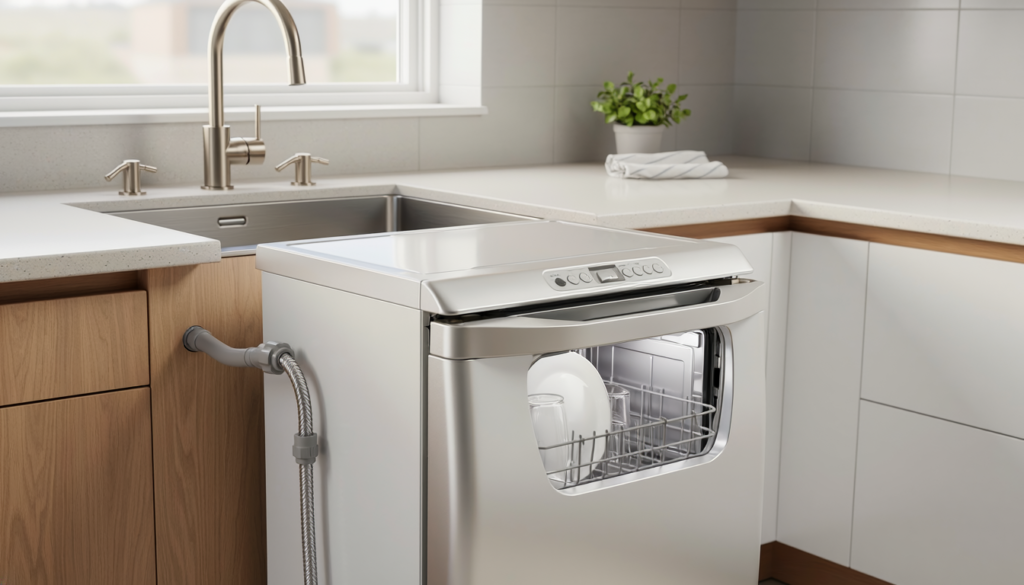
Best Compact Dishwasher for an Apartment
Disclosure: As an Amazon Associate, My Indoor Space may earn from qualifying purchases made through links in this guide, at no extra cost to you.
A compact dishwasher can save time in a small kitchen, but only if it fits the counter, accepts your dishes, and connects to the sink without disrupting daily use. Countertop, built-in slimline, and rolling portable models solve different space problems.
Quick verdict
For most renters, the best compact dishwasher is a countertop model with a faucet hookup, stainless interior, removable filter, simple normal and quick cycles, and enough vertical clearance for everyday plates. Choose a built-in 18-inch model only when cabinetry, plumbing, permission, and budget support permanent installation.
Who it is for—and who should skip it
A compact dishwasher suits one- or two-person homes, rental kitchens without a built-in unit, basement suites, and anyone who wants to reduce sink clutter. It works best when small loads are run regularly.
Skip it if the faucet is incompatible, counter space is already scarce, drainage would be unsafe, or your plates and cookware exceed the rack dimensions. Lease and building rules may also limit temporary appliance connections.
Compare the three main types
| Type | Best for | Main trade-off |
|---|---|---|
| Countertop faucet-connect | Most renters | Uses counter and sink access |
| Countertop tank-fill | Incompatible faucets | Manual filling and drainage |
| Rolling portable | Larger loads and more storage | Needs floor space and movement |
| 18-inch built-in | Permanent small kitchens | Installation and cabinet work |
Best value: faucet-connect countertop model
A standard countertop unit offers the best value when the faucet accepts its quick-connect adapter. It draws and drains automatically during the cycle, avoiding repeated manual filling.
Check the faucet aerator threads before buying. Pull-down, touchless, designer, and non-standard faucets may not accept the supplied adapter. Do not force a connection or use an improvised pressurized fitting.
Upgrade worth it: stainless interior and better rack
A stainless-steel interior is a useful upgrade for durability, stain resistance, and heat retention. Rack design matters just as much: folding tines, a removable cutlery basket, and a sensible spray-arm path can make a compact tub far more usable.
A built-in water tank is worthwhile when faucet connection is impossible. Confirm how many fill pitchers are needed, whether a level indicator is visible, and where the drain hose will empty.
Measure the full operating space
Measure width, depth, height, door-open clearance, and the path for hoses and power. Include upper cabinets and the space needed to load from the front. A machine may fit on the counter but still be impossible to open fully.
Check the unit’s maximum plate diameter and usable rack height. Place settings are standardized estimates and do not guarantee that your dinner plates, mugs, or saucepan will fit together.
Water supply and drainage
A faucet-connected model temporarily takes over the faucet during operation. The adapter, hose, and sink must remain secure and unobstructed. A tank-fill model still needs a stable drain hose positioned exactly as instructed.
Never leave a new setup unattended until you have observed complete fill, wash, drain, and dry cycles without leaks. Keep connections accessible and inspect them regularly.
Noise in a small apartment
In an open-concept apartment, a few decibels can affect conversation and television listening. Compare published noise ratings, but also consider pump tone, drain noise, and end-of-cycle beeps.
Rubber feet and a level, solid counter reduce vibration. Do not place the dishwasher on a weak cart or uneven surface.
Cycles and drying
Normal, quick, and intensive cycles cover most needs. Specialty fruit or baby-item modes are not substitutes for following food-safety or sanitation guidance. A long feature list is less valuable than dependable cleaning and an accessible filter.
Compact machines often use residual heat or airflow rather than a powerful heated dry. Opening the door after the cycle when the manual allows it can help moisture escape.
Running cost and maintenance
Use only dishwasher detergent in the amount recommended for the water and load. Hand dish soap can create excessive foam and leaks. Clean the filter, spray arm, door seal, and interior as directed.
Scrape solid food but do not assume every item is dishwasher safe. Wood, cast iron, sharp knives, insulated drinkware, and delicate finishes may need hand washing.
Common buying mistakes
- Ordering before checking faucet-thread compatibility.
- Measuring the closed machine but not the open door.
- Trusting place-setting capacity instead of rack dimensions.
- Using hand dish soap.
- Letting a drain hose move out of the sink.
- Assuming countertop means lightweight or easy to relocate.
Frequently asked questions
Do countertop dishwashers need plumbing?
Many connect temporarily to a faucet and drain into the sink. Tank-fill models avoid the pressurized faucet connection but still require drainage.
Can I use one with a pull-down faucet?
Often not with the standard adapter. Check the exact faucet and dishwasher compatibility rather than buying an unapproved adapter.
Will full-size plates fit?
Some do and some do not. Compare the stated maximum plate diameter with your own dishes and allow for spray-arm clearance.
Can renters install one?
A temporary countertop model may be acceptable, but the lease, insurer, building rules, and landlord determine what is permitted.
Final winner
The best compact dishwasher for most apartments is a faucet-connect countertop model with verified faucet compatibility, a stainless interior, removable filter, flexible rack, and clear leak-free hose routing. When the faucet will not cooperate, choose a tank-fill model rather than forcing an unsafe connection.
Make the most of a tight kitchen with our small-kitchen pantry organizer guide and food storage container comparison.