
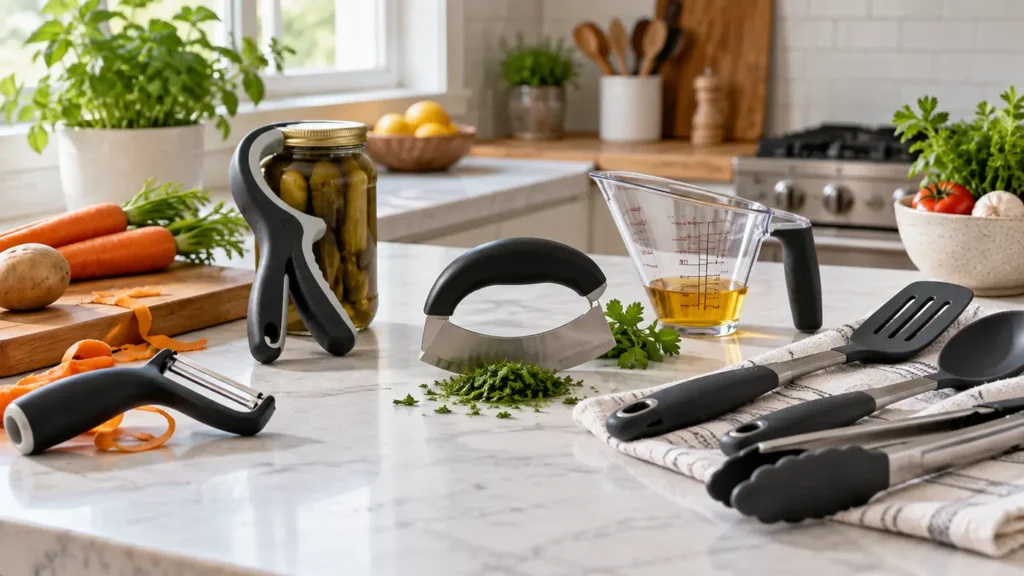
Best Ergonomic Kitchen Tools for Easier Meal Prep
Disclosure: As an Amazon Associate, My Indoor Space may earn from qualifying purchases made through links in this guide, at no extra cost to you.
Comfortable kitchen tools can make chopping, peeling, opening, stirring, and serving feel less demanding. The most useful designs reduce unnecessary grip force, keep the wrist closer to a neutral position, and provide enough control without adding bulk.
Ergonomic is not a single certification or guarantee. Handle shape, weight, balance, leverage, and the task itself all matter. A tool that feels excellent in one hand may be awkward in another, so focus on fit and function instead of a label.
Quick verdict
Prioritize wide non-slip handles, low operating force, balanced weight, and controls that can be used without pinching. Start with the task that causes the most fatigue—such as peeling, opening cans, or cutting—then replace only the tools that will meaningfully improve it.
What to compare first
| Feature | Why it matters | Practical target |
|---|---|---|
| Handle | Controls grip pressure | Wide, rounded, non-slip |
| Weight | Affects fatigue and control | Light but well balanced |
| Mechanism | Determines operating force | Leverage or powered assist |
| Cleaning | Shapes daily usability | Few seams, removable parts |
What ergonomic design really means
A helpful tool should suit the motion required for the job. A broad handle spreads pressure across more of the hand, while a textured surface can reduce the need to squeeze. Angled handles may keep the wrist straighter during repetitive work.
Do not assume a thick handle is automatically comfortable. If it is too large, sharply contoured, or slippery, it can reduce control. Whenever possible, check dimensions and return policies before buying.
Choose knives and cutting tools for control
A sharp knife requires less force than a dull one. Look for a handle that feels secure, a manageable blade length, and balance that does not pull the wrist forward. A stable cutting board with a non-slip base is just as important.
Rocker knives, food choppers, or spring-assisted scissors can be alternatives for particular tasks. Keep guards and locks functional, follow the manufacturer’s care instructions, and store sharp edges safely.
Look for leverage in peelers and openers
A swivel peeler with a padded handle can follow the food while reducing wrist adjustment. Jar openers, bottle openers, and can openers should multiply force instead of depending on a tight pinch grip.
Powered tools may help with repetitive jobs, but they add batteries, motors, and cleaning steps. Check whether the controls are easy to reach and whether the device stops safely if it meets resistance.
Select mixing and serving tools by handle shape
Spatulas, spoons, ladles, and whisks with rounded handles are often easier to hold than thin flat metal shafts. A heat-resistant grip and a tool length matched to the pan can prevent awkward reaching.
For heavy mixtures, use a bowl with a non-slip base and a tool that does not flex excessively. Lightweight tools are useful, but an unbalanced head can still strain the wrist.
Consider appliance controls and setup
Large buttons, clear markings, one-touch operation, and easy-to-remove attachments can matter as much as motor power. Keep frequently used appliances within comfortable reach so they do not need to be lifted from a low cabinet each time.
An immersion blender can reduce transfers between a pot and countertop blender, while a lightweight electric can opener may reduce repetitive turning. Choose only appliances you can clean, store, and operate confidently.
Test grip, reach, and dominant-hand assumptions
Some tools are shaped for right-handed use, while others are symmetrical. Left-handed cooks should check blade orientation, locking mechanisms, and scale markings. People with smaller hands may prefer a narrower grip than generic ergonomic designs offer.
If pain, numbness, weakness, or loss of coordination is persistent, consult a qualified clinician or occupational therapist. Kitchen tools can improve convenience, but they do not diagnose or treat an underlying condition.
Make the work surface part of the solution
Tool choice cannot compensate for a counter that is too high, a sliding board, or ingredients placed out of reach. Bring the task close to the body, use a stable mat or damp towel under the board, and sit for prep when that is safer and more comfortable.
Break long prep jobs into shorter steps and alternate motions when possible. A simple mise en place—ingredients opened and arranged before cooking—also reduces rushed gripping and reaching.
Common buying mistakes
- Buying a complete set without testing the most important handle sizes.
- Choosing a heavy powered tool that is tiring to lift or difficult to clean.
- Using dull blades, which require more force and are harder to control.
- Assuming every ergonomic product works equally well for left- and right-handed users.
- Treating a tool purchase as a substitute for professional advice about persistent pain or weakness.
Frequently asked questions
What makes a kitchen tool ergonomic?
It should reduce unnecessary force or awkward motion while remaining easy to control. Handle shape, texture, weight, balance, and leverage all contribute.
Are thicker handles always better?
No. A handle should match the user’s hand and the task. Too much thickness can make a tool difficult to control, especially for smaller hands.
Are electric kitchen tools easier to use?
They can reduce repetitive force, but only if the controls, weight, cleaning, and storage are manageable. Compare the full routine, not just the powered step.
Which tool should I replace first?
Replace the item used most often for a task that feels difficult or tiring. Common starting points are peelers, can openers, knives, jar openers, and mixing utensils.
Can ergonomic tools help with arthritis?
Some designs may make tasks more comfortable by reducing grip force, but needs vary. A clinician or occupational therapist can recommend adaptations for an individual condition.
Who should buy them—and who should skip
Buy ergonomic tools if: gripping, twisting, peeling, chopping, or opening containers causes fatigue and a better handle or leverage would make meal prep easier.
Skip replacing tools that already feel comfortable and give you good control.
Best value
Upgrade the one or two tools that cause the most strain first. A comfortable peeler, opener, or knife can deliver more value than buying a large matching set.
When the upgrade is worth it
Pay more for better handle shape, useful leverage, balanced weight, and replaceable parts when the tool is used often. Gimmicky multi-tools are rarely worth extra.
Final answer
The best ergonomic kitchen tools fit the user, reduce force, and remain simple to control and clean. Buy for a specific task, pay attention to handle dimensions and weight, and improve the workstation at the same time. Thoughtful choices can make everyday prep smoother without filling the kitchen with unnecessary gadgets.
You may also find our guides to the best immersion blender features and electric kettle buying considerations useful.