
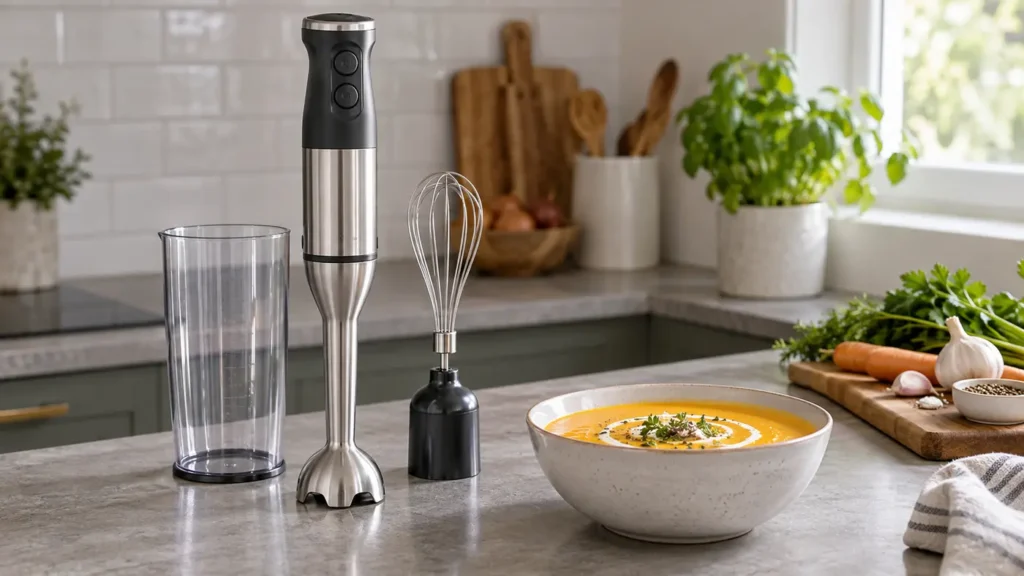
Best Immersion Blender: Features That Actually Matter
Disclosure: This post contains affiliate links. If you buy through one of our links, we may earn a commission at no extra cost to you. Keep hands and utensils away from the blade, unplug before cleaning or changing attachments, and follow the manufacturer’s instructions.
An immersion blender can puree soup in the pot, make a quick smoothie in a cup and emulsify dressing without taking over the counter. It is one of the most space-efficient small appliances, but only when the motor body is comfortable to hold and the blending head is designed to control splashing.
The best model for most kitchens is not the one with the largest wattage claim or the biggest attachment bundle. Control, balance, shaft length, guard shape and cleaning are more important.
Quick verdict
Choose a variable-speed immersion blender with a stainless-steel removable shaft, a comfortable trigger or dial, and a blade guard that can move food without scratching cookware. A blending cup is useful; a whisk is worthwhile if you will actually use it. Buy a mini chopper attachment only when it replaces another appliance.
Immersion blender configurations
| Setup | Best for | Advantages | Tradeoffs |
|---|---|---|---|
| Basic blender | Soups, sauces and dressings | Lowest clutter and simplest cleaning | Fewer extra jobs |
| Blender plus whisk | Cream, eggs and light batters | Useful second function with little storage | Not a replacement for a heavy mixer |
| Multi-piece kit | Small kitchens replacing several tools | Can include cup, whisk, chopper and masher | More parts, lids and storage |
| Cordless | Fast jobs away from an outlet | No cord around the pot | Battery charging, weight and long-term replacement |
Control matters more than maximum power
A powerful motor helps with fibrous vegetables and thicker mixtures, but a blender that jumps to full speed can throw hot soup up the sides of the pot. Progressive trigger control or several genuinely distinct speeds give you a gentler start.
Wattage is not a direct guarantee of blending performance. Blade geometry, guard openings, motor efficiency and how easily ingredients circulate all matter. Look for consistent results and manageable vibration rather than shopping by one number.
Choose the right shaft length
A longer shaft reaches into stockpots and tall pitchers, while a shorter shaft can feel easier to control in a small saucepan. Measure the containers you use most. The blade head needs to stay submerged, but the motor housing should remain well above the food.
A removable shaft is easier to wash and store. Stainless steel tolerates hot-food use better than some plastic shafts, but always confirm the model’s temperature limits. Never immerse the motor body.
Blade guard design and cookware
The bell around the blade controls circulation and helps protect the blade from the pot. Wide openings move thick food more freely; a very closed guard may trap chunks. Some guards have soft edges intended to reduce scratching, though safe technique is still important.
Keep the head slightly tilted and move slowly through the food rather than pressing hard against the bottom. If your cookware has a delicate nonstick coating, confirm the manufacturer’s recommendation before allowing a metal guard to touch it.
Corded or cordless?
A corded immersion blender is usually lighter, always ready and better suited to longer sessions. Check cord length and where the outlet sits in relation to your stove and prep area. Keep the cord away from heat, water and the pot rim.
Cordless models remove the cord from the workspace but add battery weight. Consider charging time, runtime, battery availability and whether the appliance can operate while charging. A cordless tool is only convenient if it is charged when you need it.
Attachments worth having
- Blending cup: helps with small batches and gives the blade enough depth to work.
- Whisk: useful for whipped cream, eggs and thin mixtures.
- Mini chopper: valuable for herbs, nuts and onions when it truly replaces a separate chopper.
- Potato masher: can produce an even texture without overworking starch when used correctly.
Attachment bundles often look like a bargain, but each part needs storage and cleaning. Start with the jobs you already do. A basic blender that lives within reach will be used more than a large kit buried in a cupboard.
Comfort and one-handed use
Weight is concentrated in the handle, so a small difference becomes noticeable during a long blend. Look for a grip you can hold securely with dry or slightly damp hands. Buttons should not require excessive pressure, and speed controls should be reachable without changing your grip.
If hand strength is limited, a lock-on design may feel easier than holding a stiff trigger, but it also requires careful control. Try the grip in person when possible and check the total assembled weight rather than motor weight alone.
Reducing splashes
- Use a container tall enough for the food volume.
- Submerge the blade guard before starting.
- Begin at low speed.
- Keep the head below the surface while the blade is moving.
- Stop the motor before lifting it out.
- Let very hot mixtures cool to the recommended temperature.
Do not fill a narrow cup so high that movement has nowhere to go. For hot soup, remove the pot from active heat and work in controlled pulses. Never blend in a container that can tip or shatter.
Cleaning and storage
Unplug the blender or disconnect the power unit before removing the shaft. Wash the detachable components as directed and take care around the sharp blade. If the shaft is dishwasher-safe, check whether the top rack is required. The motor body usually needs only a damp cloth.
Rinse soon after blending sticky foods so residue does not dry around the guard. Dry connections completely before reassembly. Store the shaft where its blade cannot be reached accidentally and where the coupling is not carrying the appliance’s weight.
Common buying mistakes
- Buying the largest attachment kit without storage space
- Choosing by wattage alone
- Ignoring the assembled weight and button pressure
- Using a metal guard carelessly on delicate cookware
- Assuming every shaft is safe in very hot food
- Expecting an immersion blender to crush large amounts of ice
- Forgetting to check replacement attachment availability
Who may prefer a countertop blender?
A countertop blender is better for large smoothies, frequent ice crushing, very silky purees and jobs that need a closed jar. An immersion blender wins for soup in the pot, quick sauces, small batches and easy storage. Many homes need only one, so choose from the tasks you perform every week.
Frequently asked questions
Can an immersion blender blend hot soup?
Many are designed for soup, but the model’s temperature guidance must be followed. Remove the pot from active heat, keep the head submerged and start slowly to reduce splashing.
Can it replace a regular blender?
It can for soups, sauces, dressings and some smoothies. It is less suitable for large frozen drinks, heavy ice crushing or consistently ultra-smooth results.
Is a cordless model better?
It is more convenient around the pot, but usually heavier and dependent on a charged battery. A corded model is the better-value choice for many kitchens.
Do I need variable speed?
Yes, if you make hot soup or small batches. A gentle starting speed improves control and reduces splashing.
Will it scratch my pot?
It can if a hard metal guard is pressed or dragged against a delicate surface. Check both appliance and cookware instructions and use careful technique.
Shop immersion blenders
Compare grip comfort, variable-speed control, shaft length, guard material, attachment usefulness and cleaning instructions.
Shop Amazon USA
Shop Amazon Canada
Who should buy it—and who should skip it
Buy it if: you make soups, sauces, smoothies, or purées directly in a pot or tall container and value quick cleanup.
Skip it if: you mainly crush ice, make large frozen drinks, or need the broader capacity of a countertop blender.
Best value
A corded immersion blender with a removable stainless shaft and simple variable speed is the best value for most kitchens.
When the upgrade is worth it
Pay more for better low-speed control, a more comfortable grip, and useful whisk or chopper attachments when you will actually use them. Extreme wattage claims alone are not a reason to upgrade.
Final answer
For most kitchens, the best immersion blender is a balanced corded model with variable speed, a removable stainless-steel shaft and a useful blending cup. Add a whisk if it matches your routine, but avoid paying for attachments you will store rather than use. Control and cleanup matter more than an extreme power claim.
For other compact countertop choices, see our countertop ice maker guide and electric kettle guide.