
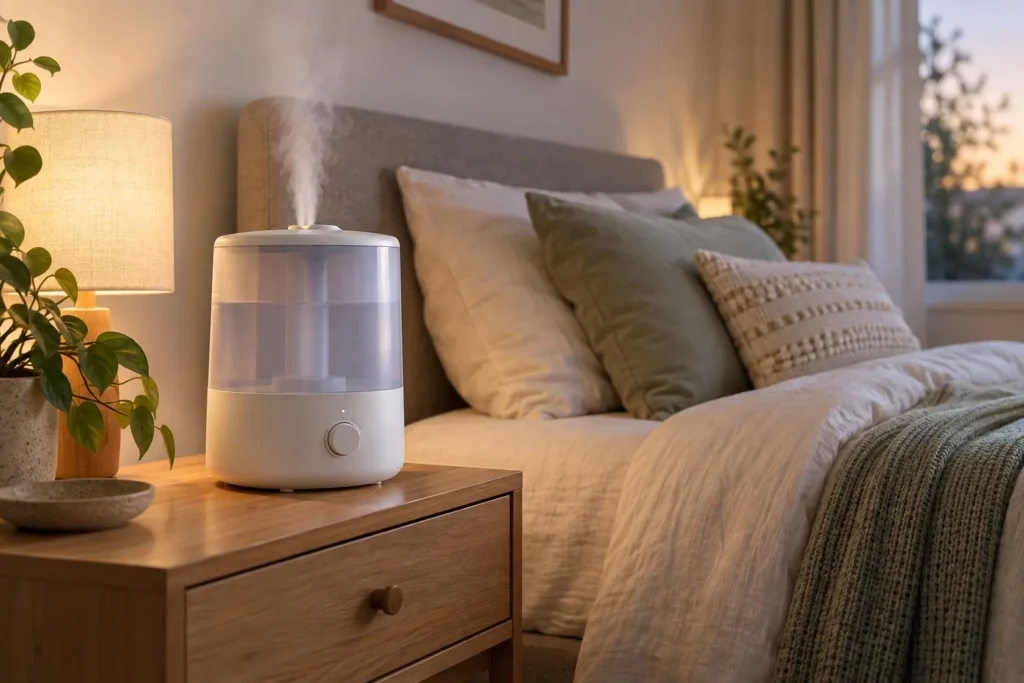
Best Bedroom Humidifier: What to Look For
Disclosure: This article contains affiliate links. If you buy through them, My Indoor Space may earn a commission at no extra cost to you.
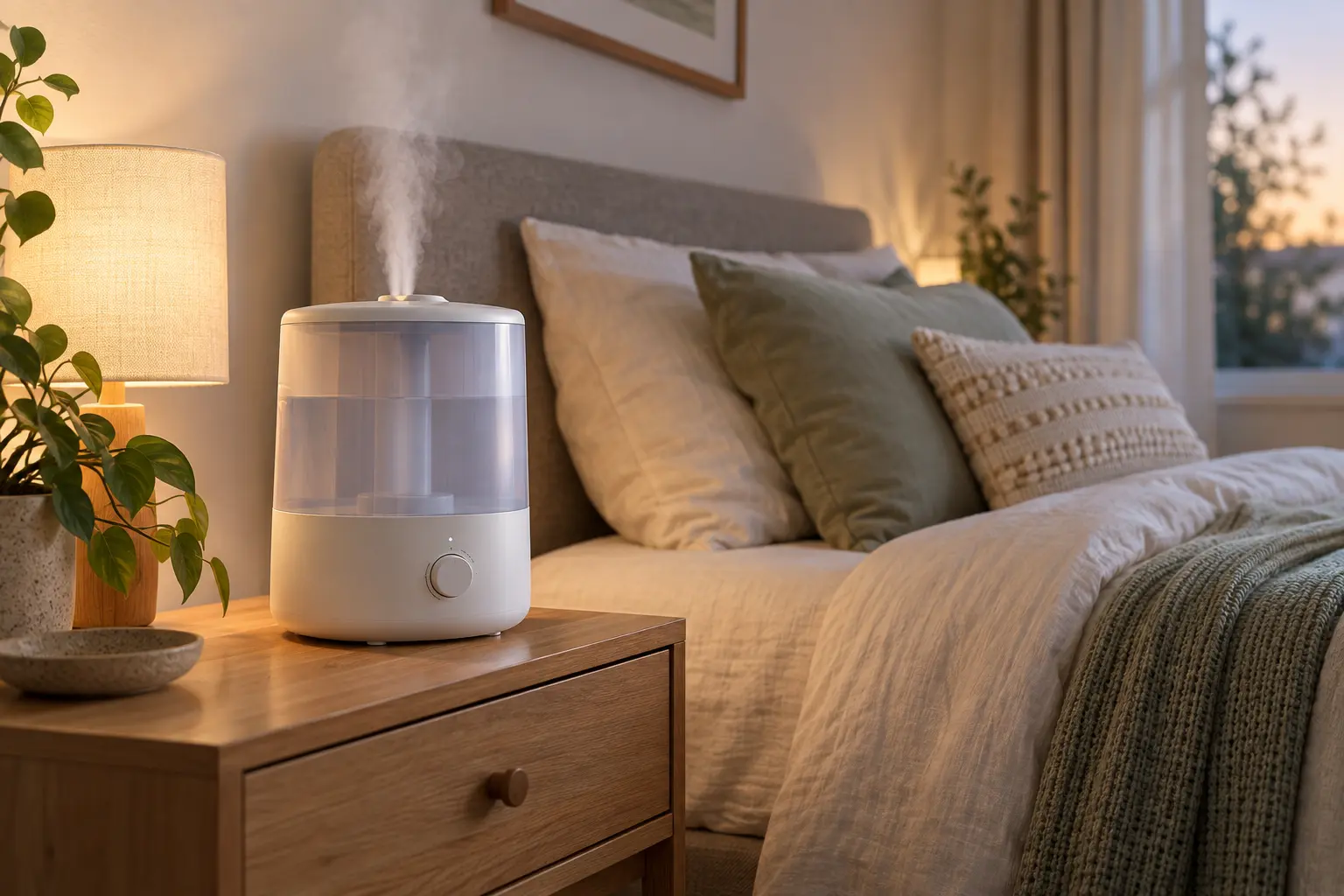
A bedroom humidifier can make dry indoor air feel more comfortable, but only when the machine is correctly sized, easy to clean and used without pushing humidity too high. The best model is not the one that produces the biggest cloud of mist. It is the one you can maintain consistently and control accurately through the night.
Quick Verdict
Best choice for most bedrooms: a quiet cool-mist humidifier with a built-in humidistat, automatic shutoff, adjustable output and a tank that opens widely for cleaning.
Best value: a simple evaporative or ultrasonic model paired with a separate digital hygrometer so you can see the room’s actual relative humidity.
Upgrade worth considering: top-fill construction, dishwasher-safe parts where permitted, a reliable humidistat and an easy-to-read display that can be dimmed completely at night.
Who a Bedroom Humidifier Is Best For
- Homes where heated winter air regularly feels uncomfortably dry.
- People who want controlled moisture rather than simply running mist continuously.
- Bedrooms where a hygrometer confirms that relative humidity is low.
- Anyone willing to empty, refill and clean the tank on schedule.
Who May Want to Skip It
- Rooms that already stay humid or show condensation on windows.
- Anyone unlikely to clean a water tank and wetted parts regularly.
- Bedrooms with an unresolved leak, damp carpet or visible mold.
- People expecting a humidifier to diagnose or treat a health condition.
Start With a Hygrometer
Before buying a humidifier, measure the bedroom’s relative humidity with a small digital hygrometer. General indoor-air guidance often places comfortable home humidity around 30% to 50%, but the practical target can vary with outdoor temperature, insulation and condensation. If windows become wet or the room smells damp, reduce the setting or stop the machine.
A humidifier without a humidity reading can easily run longer than needed. A separate hygrometer is inexpensive, can be placed away from the mist stream and lets you check whether the built-in sensor is behaving realistically.
Choose the Right Humidifier Type
| Type | Best for | Main trade-off |
|---|---|---|
| Ultrasonic cool mist | Quiet bedrooms and low power use | May leave mineral dust when used with hard water |
| Evaporative | Natural output that slows as humidity rises | Fan noise and replacement wick costs |
| Warm mist | People who prefer a warm visible mist | Hot water and steam create a burn risk |
| Dual mist | Households wanting warm and cool options | Higher price and more parts to clean |
| Whole-room console | Large rooms or connected spaces | Bulky for a normal bedroom |
Eight Features That Matter Most
1. Room-Size Rating
Measure the bedroom floor area before shopping. Multiply length by width to get square footage. Treat advertised coverage as a starting point rather than a guarantee because ceiling height, ventilation, door position and outdoor dryness all affect performance. An oversized unit can raise humidity too quickly, while an undersized one may run constantly.
2. A Real Humidistat
A humidistat lets you choose a target and allows the machine to cycle instead of producing mist without feedback. The sensor should not sit directly in the mist path. Compare it with a separate hygrometer during the first few nights and adjust the target if the readings differ.
3. Easy Tank Access
A wide top opening makes daily emptying, wiping and refilling much easier. Check whether your hand can reach the interior surfaces and whether the tank stands securely in a sink. Narrow decorative tanks may look elegant but can be frustrating to clean thoroughly.
4. Low-Water Automatic Shutoff
The unit should stop when the tank is empty. This is especially important overnight, when you may not notice that the water has run out. A clear indicator is useful, but it should dim or turn off in sleep mode.
5. Quiet Operation
Ultrasonic models are usually quiet, although some produce faint bubbling or electronic sounds. Evaporative models contain a fan and may be more noticeable. Look beyond a single decibel claim: fan speed, water movement and button beeps can matter just as much in a quiet bedroom.
6. Adjustable Output and Mist Direction
Variable output helps you match the machine to changing weather. A rotating nozzle lets you direct mist into open air instead of toward bedding, walls or electronics. The goal is even room humidity, not a damp zone around the machine.
7. Manageable Filter and Part Costs
Evaporative humidifiers need replacement wicks, and some ultrasonic models use demineralization cartridges. Check availability and cost before buying. A low-priced machine can become expensive if it requires a proprietary part every few months.
8. Controls That Disappear at Night
Sleep mode should reduce fan speed, dim the display and silence unnecessary alerts. Physical buttons are often easier to use in the dark than a touchscreen. App control can be convenient, but it is not a substitute for simple controls on the machine.
How Large Should the Tank Be?
A bigger tank does not automatically mean better performance. It mainly means fewer refills. For a normal bedroom, choose enough capacity to cover your usual sleep period at the setting you actually need. Published runtime is commonly measured on the lowest output, so maximum-output runtime may be much shorter.
Also consider lifting weight. One litre of water weighs about one kilogram before the tank itself is added. A huge tank can be awkward to carry, turn over and fit beneath a faucet.
Ultrasonic Humidifiers and White Dust
Ultrasonic humidifiers can disperse minerals found in tap water, leaving pale dust on nearby furniture. The amount depends on the water and machine. Distilled or demineralized water may reduce it, and some models accept a demineralization cartridge. Follow the manufacturer’s water instructions rather than adding treatments or fragrances that are not approved for the tank.
Where to Place a Humidifier in a Bedroom
- Use a stable, level and water-resistant surface.
- Keep it away from the edge where it could be knocked over.
- Leave clearance from walls, curtains, books and electronics.
- Point the mist into open room air rather than at the bed.
- Protect wood furniture according to the manufacturer’s placement instructions.
- Keep the cord away from walkways and never route it beneath a rug.
- Follow the manual’s minimum clearance and height guidance.
If the bedroom feels crowded, first simplify the surface around the unit. The ideas in How to Organize a Bedroom Without Buying More Furniture can help you create a safer dedicated spot.
Cleaning Is Not Optional
Standing water and residue can allow microorganisms to grow. Empty leftover water, wipe accessible surfaces dry and refill with fresh water regularly. Clean and descale on the schedule and with the method specified in the manual. Unplug the base before filling or cleaning, and never submerge electrical parts.
The U.S. Consumer Product Safety Commission advises regular cleaning and warns against over-humidifying; moisture on windows or walls is a clear sign to reduce output. Its indoor-air guidance also recommends fresh water and frequent cleaning for cool-mist and ultrasonic units.
Best Value vs. Upgrade Worth Buying
Best value: a correctly sized cool-mist unit with adjustable output, low-water shutoff, a wide tank opening and a separate hygrometer. Easy maintenance is more valuable than a long list of modes.
Upgrade worth buying: a dependable built-in humidistat, top-fill tank, fully dimmable display and parts that are genuinely easy to remove and clean.
Upgrade most people can skip: voice control and elaborate mood lighting. Neither improves moisture control, tank hygiene or bedroom comfort.
Frequently Asked Questions
Should a humidifier run all night?
Only if the room needs it and humidity remains controlled. Use a humidistat or hygrometer, choose a moderate setting and stop if condensation appears. Continuous mist without measurement can make the room too damp.
Is cool mist or warm mist better for a bedroom?
Cool mist is the practical choice for most bedrooms because it avoids a hot-water and steam hazard. Warm mist may appeal to some adults, but it requires extra care and is a poor choice where children or pets could reach it.
Can a humidifier replace an air purifier?
No. A humidifier adds moisture; an air purifier filters airborne particles. They perform different jobs. If you use both, give each appliance open space and follow the placement guidance in Best Places to Put an Air Purifier.
Can essential oils go in the water tank?
Only when the manufacturer explicitly allows it and provides a dedicated tray or compartment. Oils can damage ordinary humidifier plastics, seals and ultrasonic components. Never assume an aroma diffuser and a humidifier are interchangeable.
Availability, prices and specifications change. Confirm the room-size rating, safety features, cleaning instructions, electrical certification and warranty on the retailer’s page before purchasing.
Final Answer
For most bedrooms, choose a quiet cool-mist humidifier sized for the room, with a built-in humidistat, low-water shutoff, adjustable output and a tank you can easily reach and clean. Pair it with a separate hygrometer, keep the room below the point where condensation appears and treat daily water care as part of owning the machine.