What Size Dehumidifier Do I Need?
Disclosure: This post contains affiliate links. If you buy through one of our links, we may earn a commission at no extra cost to you. A dehumidifier manages airborne moisture; it does not repair leaks, stop water intrusion, or replace proper mold remediation.
Dehumidifier size is measured by how many pints of water the machine can remove in 24 hours under specified test conditions—not by the physical size of the cabinet. The right capacity depends on the area, how damp it is, the room temperature, air leakage, laundry or shower moisture, and whether you can drain the collected water continuously.
Square footage is only the beginning. A moderately damp 1,000-square-foot basement can need less capacity than a much smaller room with seepage, wet laundry, or very high relative humidity. This guide helps you choose a practical portable dehumidifier and set it up safely.
Quick answer
For a small-to-medium space under about 2,000 square feet, ENERGY STAR’s current buying guidance suggests roughly:
| Condition without dehumidification | Typical relative humidity | Starting capacity |
|---|---|---|
| Slightly to moderately damp; intermittent musty odor | About 50–75% RH | 20–30 pints/day |
| Very damp; persistent odor or damp spots | About 75–90% RH | 25–40 pints/day |
| Wet; sweating surfaces, seepage, or high moisture load | About 90–100% RH | 30–50 pints/day |
For spaces over 2,000 square feet, the same guidance starts at 30+ pints for moderately damp conditions, 40+ for very damp conditions, and 50+ for wet conditions. Treat these as estimates. Persistent water, visible mold, or a structural moisture problem needs diagnosis—not merely a larger appliance.
Start by measuring humidity
Use a separate hygrometer to observe relative humidity over several days. Check morning, evening, rainy weather, and after activities such as showering or drying laundry. A single reading can miss the real pattern, and the sensor built into a dehumidifier may read the air immediately around the unit rather than the whole room.
The U.S. Environmental Protection Agency recommends keeping indoor relative humidity below 60%, ideally around 30% to 50% where practical. ENERGY STAR also describes 30% to 50% RH as a generally desirable building range. Very low humidity can feel uncomfortable, so more drying is not always better.
Capacity is water removal, not tank size
A “35-pint” dehumidifier does not necessarily have a 35-pint bucket. The capacity rating describes water removal over 24 hours at a defined temperature and humidity; the bucket may hold only a fraction of that. In a damp room, you could empty it several times a day unless you use continuous drainage.
Newer capacity labels may look lower than older ones because federal test conditions changed. ENERGY STAR explains that portable units began using a cooler, more realistic test condition, so a newer 30-pint model may be comparable to an older model labeled much higher. Compare products using the same current standard whenever possible.
How room conditions change the size you need
Basement seepage or wet walls
Stop the water source first. Correct grading, gutters, plumbing leaks, cracks, drainage, or waterproofing as appropriate. A dehumidifier can help with residual airborne moisture, but running continuously against active seepage wastes energy and can conceal a worsening problem.
Laundry drying indoors
Wet clothes add a significant intermittent moisture load. Choose more capacity, improve exhaust or ventilation where appropriate, and consider continuous drainage. Keep the appliance clear of splashes and follow electrical-safety instructions.
Cool basement or garage
Compressor dehumidifiers can lose performance or frost in cool air. ENERGY STAR advises considering a model specified for lower-temperature operation when the space often falls below about 65°F (18°C). An automatic defrost function helps, but check the exact rated operating range.
Open floor plan
A portable unit works best in a reasonably contained area. Open stairs, frequently opened exterior doors, or multiple closed rooms make one unit’s job harder. Air needs a return path; a machine in one closed room will not reliably control humidity behind other closed doors.
Bathroom
Fix or upgrade exhaust ventilation first. Many portable dehumidifiers are not designed to sit in wet zones, and electrical clearances matter. Never place one where it can be splashed or reached from a tub or shower unless the product and installation are explicitly rated for that use.
Choose the drainage method before the capacity
| Drainage | Best for | Watch for |
|---|---|---|
| Manual bucket | Occasional use and easy access | Frequent emptying; unit stops when full |
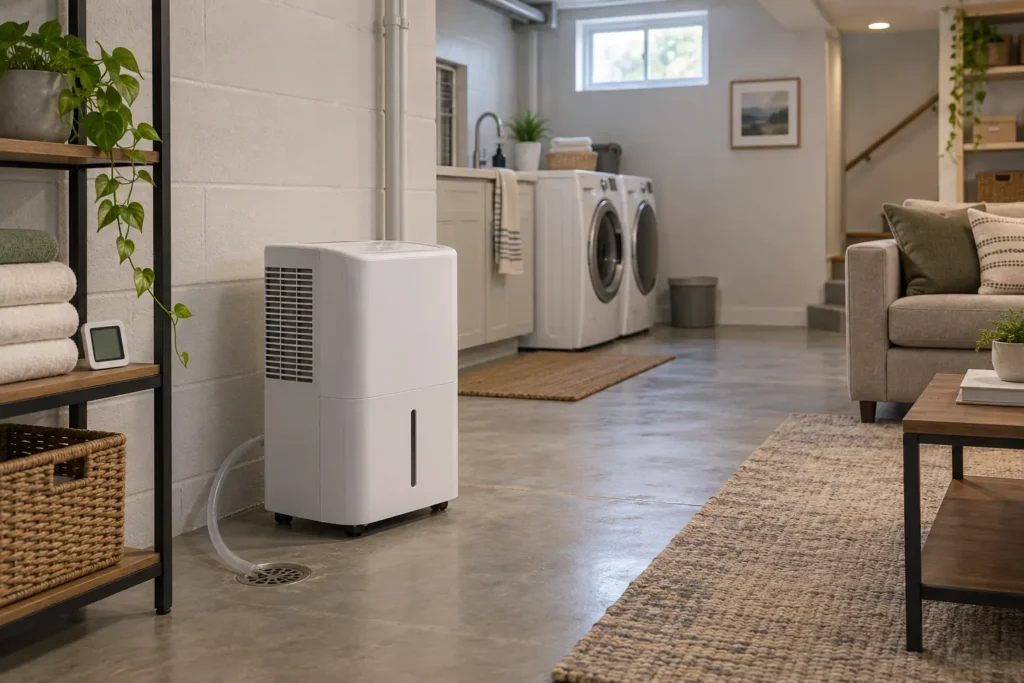
| Gravity hose | Nearby floor drain lower than outlet | Continuous downhill slope; kinks and trip hazards |
| Built-in pump | Sink or drain above the unit | Pump lift limit, hose routing, added noise and maintenance |
| External condensate pump | Flexible permanent drainage | Separate equipment, overflow protection, safe installation |
A gravity hose must slope downward the entire way; it cannot push water uphill. Secure the hose at the drain, keep it away from electrical cords, and periodically inspect for slime, kinks, or blockage. Never route drainage where a leak could damage finished surfaces.
Features worth paying for
- Accurate adjustable humidistat: lets the unit cycle instead of running constantly.
- Automatic restart: helpful after a power interruption, provided settings are retained safely.
- Low-temperature or defrost control: important in cool basements.
- Continuous-drain connection: valuable for persistent moisture.
- Washable, accessible air filter: easier routine maintenance.
- ENERGY STAR certification: provides a verified efficiency basis for comparison.
- Full-bucket shutoff: standard on many models and essential for bucket use.
Efficiency, noise, and heat
Dehumidifier efficiency is expressed as Integrated Energy Factor, or liters of water removed per kilowatt-hour. A higher IEF means more water removal for the electricity used under the test method. Compare models within an appropriate capacity class.
Every refrigerant dehumidifier adds some heat to the room while operating. That can be welcome in a cool basement but uncomfortable in a warm bedroom. For sleeping spaces, compare low-fan sound levels, compressor cycling character, display dimming, and whether the unit resumes loudly after a power interruption.
Portable vs whole-home dehumidifier
A portable unit makes sense for one basement, bedroom, storage room, or another defined area. A whole-home unit connects to ductwork and is intended to manage moisture across a larger conditioned area. Whole-home sizing, duct design, condensate disposal, and controls should be handled by an HVAC professional.
If you need portable units in many rooms or the central air conditioner leaves the entire home clammy, the building envelope and HVAC system may need assessment. Oversized air conditioning, air leakage, duct problems, or inadequate ventilation can contribute to humidity issues.
Placement and setup
- Use a grounded outlet that meets the manual’s requirements; avoid extension cords unless the manufacturer explicitly permits one.
- Leave the specified clearance around air intakes and exhaust. Do not crowd the unit behind furniture.
- Close windows and exterior doors while operating, unless a ventilation plan says otherwise.
- Keep the unit away from dust-producing work, which can clog coils and filters.
- Place it on a stable, level surface and protect the drainage route.
- Set an initial target around 45% to 50% RH, then confirm with a separate hygrometer.
For official capacity and placement guidance, see ENERGY STAR’s dehumidifier guide. For moisture and mold fundamentals, consult the EPA’s mold resources.
Maintenance that protects performance
- Clean the filter on the manufacturer’s schedule.
- Wash and dry the bucket regularly to control residue and odors.
- Inspect the hose and drain connection for blockage or leakage.
- Vacuum dust from accessible grilles with the unit unplugged.
- Allow the appliance to stand as directed after transport before turning it on.
- Check the model number against current recall information and register the product if desired.
When a dehumidifier is not the solution
Investigate urgently if you see active flooding, sewage, significant visible mold, a persistent plumbing leak, structural damage, or electrical equipment exposed to water. Porous materials that remain wet can be damaged even when room humidity later drops. A musty smell that persists at acceptable RH may indicate hidden moisture.
For a recent water event, prioritize safety, stop the source when it is safe to do so, document damage, and seek qualified help. Do not power an appliance in a wet area or handle electrical equipment while standing in water.
Frequently asked questions
Can a dehumidifier be too large?
A unit with an adjustable humidistat can cycle off at the target, so modest oversizing may provide useful reserve. But an unnecessarily large unit costs more, occupies more space, may be louder, and still will not fix a leak.
What humidity should I set?
Around 45% to 50% RH is a practical starting point for many homes. Adjust for comfort, condensation risk, climate, and building conditions while generally keeping below 60%.
Why does my dehumidifier blow warm air?
That is normal for a refrigerant dehumidifier. It removes moisture and rejects heat into the room, so discharge air feels warmer.
Will one dehumidifier handle several rooms?
Only if air circulates freely and the connected area is within the unit’s real capability. Closed doors and separate levels limit moisture transfer.
Should I run it continuously?
Use a humidistat target so the compressor can cycle as humidity falls. Continuous fan or drain operation varies by model. Persistent nonstop operation may signal an undersized unit, open windows, a blocked filter, low-temperature frosting, or an unresolved moisture source.
Shop dehumidifiers
Compare current pints-per-day ratings, rated operating temperature, IEF efficiency, drainage options, noise, filter access, and product dimensions. Confirm the capacity uses the current test standard.
Shop Amazon USA
Shop Amazon Canada
Final answer
Choose dehumidifier capacity from both the area and the dampness level. For a small-to-medium room under about 2,000 square feet, roughly 20 to 30 pints per day suits slight-to-moderate dampness, 25 to 40 pints suits very damp conditions, and 30 to 50 pints suits wet or high-load conditions. Increase capacity for larger or more demanding spaces, confirm cool-temperature performance, and choose drainage you will actually maintain. Most importantly, repair the moisture source rather than asking the appliance to fight it forever.
If humidity is mainly a bedroom comfort issue rather than a dampness problem, compare the opposite-use case in our bedroom humidifier guide.