
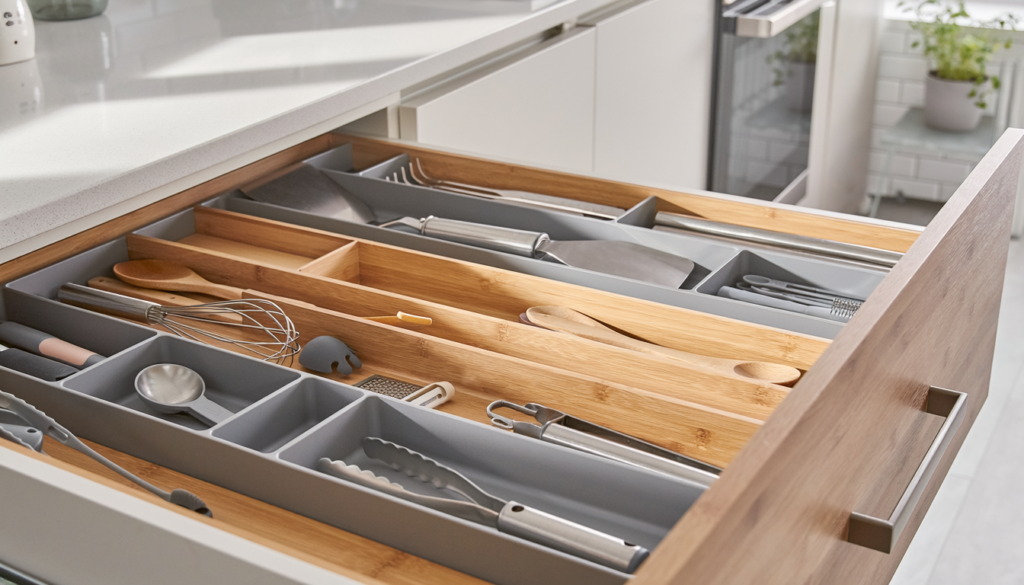
Best Organizers for Deep Kitchen Drawers
Disclosure: As an Amazon Associate, My Indoor Space may earn from qualifying purchases made through links in this guide, at no extra cost to you.
Deep kitchen drawers can hold pots, lids, dishes, food containers, and utensils, but depth alone does not create order. The best organizer keeps items upright, visible, and easy to lift without wasting space under bulky fixed compartments.
Quick verdict
For most deep drawers, adjustable dividers plus a few removable bins offer the best value. Use a pegboard system for dishes and cookware, a vertical rack for lids, and tiered inserts only when the drawer opens far enough to reveal the back section.
Who it is for—and who should skip it
Deep-drawer organization suits kitchens with lower drawers used for cookware, mixing bowls, plates, containers, baking tools, or pantry items. It also helps prevent heavy stacks from sliding each time the drawer closes.
Skip a complex insert if the drawer already has a specific purpose and stays tidy. An organizer that reduces usable space without solving a real access problem becomes clutter itself.
Compare the main organizer types
| Type | Best for | Main trade-off |
|---|---|---|
| Adjustable dividers | Mixed utensils and pantry items | Need firm tension and exact height |
| Pegboard system | Plates, bowls, pots, and lids | Higher cost and reduced floor area |
| Removable bins | Small packets and tools | Can leave awkward gaps |
| Vertical rack | Lids, boards, and pans | Requires enough drawer height |
| Tiered insert | Spices and small containers | Rear items can hide in shallow-opening drawers |
Best value: adjustable dividers
Spring-loaded or locking dividers create zones without committing the entire drawer to a fixed layout. They adapt when cookware or food-storage needs change.
Measure interior width and height at several points. Drawer sides may taper, screw heads may protrude, and slides can reduce usable space. Choose padded ends that grip without damaging the finish.
Upgrade worth it: custom-fit peg system
A pegboard base with movable pegs is worth the upgrade for heavy dishes and cookware. Pegs stop stacks from sliding and can be repositioned for bowls, pots, and lids.
Check the weight rating of the drawer and slides before loading ceramic dishes or cast iron. The organizer does not increase what the cabinet hardware can safely carry.
Measure the opening, not only the drawer box
Record the inside width, depth, height, and the vertical clearance at the cabinet frame when the drawer moves. Tall dividers may fit inside but strike the frame while opening.
Also measure how far the drawer extends. If several inches remain under the counter, keep rarely used items at the back or choose bins that lift out easily.
Organize by movement and frequency
Place frequently used items near the front and keep heavy pieces low. Group tools by task—baking, food prep, storage, or serving—rather than by colour or appearance.
Leave a little open space so items return easily. A perfectly packed drawer in a photograph can be frustrating in daily use if every tool has to be positioned exactly.
Keep stacks stable
Nonslip liner can reduce movement but must lie flat and remain clean. Vertical lid organizers need wide enough slots for handles and knobs. Pan racks need protective contact points to avoid scratching finishes.
Do not stand sharp blades loose in a deep drawer. Use a purpose-built knife organizer that protects edges and hands.
Materials and cleaning
Plastic bins are light and washable. Bamboo looks warm but needs dry care and can swell if soaked. Coated metal racks are durable when the coating remains intact.
Removable pieces simplify crumb cleanup. Avoid permanent adhesive unless you are certain of the layout and surface compatibility.
Common buying mistakes
- Measuring the drawer box but not the cabinet opening.
- Buying shallow utensil trays that waste vertical space.
- Overloading drawer slides with dishes or cookware.
- Choosing too many tiny compartments.
- Hiding daily items at the back of a partial-extension drawer.
- Using unprotected racks that scratch pans or plates.
Frequently asked questions
What is best for pots and pans?
A sturdy peg system or vertical rack works well when the drawer has enough height and weight capacity.
How do I organize food-container lids?
Store lids vertically by size in an adjustable divider or narrow bin, with matching containers nested nearby.
Do drawer dividers damage cabinets?
Padded, correctly tensioned dividers are designed to reduce marks. Avoid overtightening and inspect the finish periodically.
Is bamboo or plastic better?
Bamboo offers a finished look; plastic is lighter and easier to wash. Fit, adjustability, and cleaning habits matter more than the material alone.
Final winner
The best system for most deep kitchen drawers is a set of adjustable padded dividers combined with removable bins. It preserves usable space, adapts to changing items, and costs less than a custom insert. Choose a pegboard upgrade for heavy dishes and cookware that slide during use.
Continue the kitchen organization project with our pantry organizer guide and small habits that keep counters clear.