Author name: takeonevideoandphotos@gmail.com

Cozy Living, DIY & Decorating

How I Made My Apartment Feel Brighter Without Painting Anything
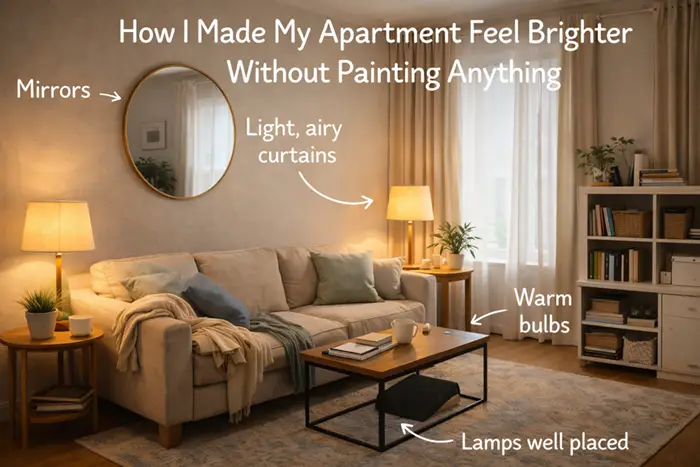
For a long time, my apartment felt dim in a way I couldn’t quite explain. It wasn’t dark exactly — there were lights on, windows uncovered — but the space still felt flat and heavy. I kept thinking the walls needed a lighter color, even though painting wasn’t an option. It turns out the problem wasn’t the walls at all.

The first real shift came from mirrors, but not in a decorative way. I stopped thinking of them as accents and started treating them like light tools. Placing one across from a window bounced daylight deeper into the room instead of letting it stop at the glass. Suddenly, mornings felt more open, and the space held onto light longer throughout the day.

Curtains mattered more than I expected too. Thick, dark panels made sense for privacy, but they were quietly blocking daylight even when open. Switching to lighter, more translucent fabric softened the light instead of cutting it off. The room didn’t glare — it glowed. Even cloudy days felt usable again.

Bulb temperature was another subtle but powerful change. Cooler bulbs made the space feel harsh without actually making it feel brighter. Warmer bulbs, especially when layered across a few lamps, gave the room depth instead of flat illumination. The light felt intentional, not exposed.

Lamp placement tied everything together. Instead of relying on one overhead source, I spread light around the room at different heights. A lamp near the couch, one in a corner, another closer to eye level — the space stopped feeling lit and started feeling alive. Shadows softened. Corners opened up. The room felt bigger without anything physically changing.

I didn’t expect something this simple to make my home feel calmer.


📦 Buy on Amazon USA

Full-length or wall-mounted mirror

Light-filtering curtains

Warm white LED bulbs (2700K)

Table or floor lamps with fabric shades


🕯️ Final Thoughts

Brightness isn’t just about more light — it’s about better light. When illumination is layered, softened, and guided, a space feels open instead of exposed. What surprised me was how much control I had without touching a paintbrush.

These changes didn’t just make the apartment look brighter — they made it feel easier to be in. Mornings felt lighter. Evenings felt warmer. The space worked with the light it already had instead of fighting it.

For renters especially, small adjustments matter. When you can’t change the walls, changing how light moves through the room can transform everything. Sometimes the brightest upgrade is simply learning where to place what you already have.
📦 Buy on Amazon Canada

Full-length or wall-mounted mirror

Light-filtering curtains

Warm white LED bulbs (2700K)

Table or floor lamps with fabric shades

Bedroom & Comfort, Cozy Living

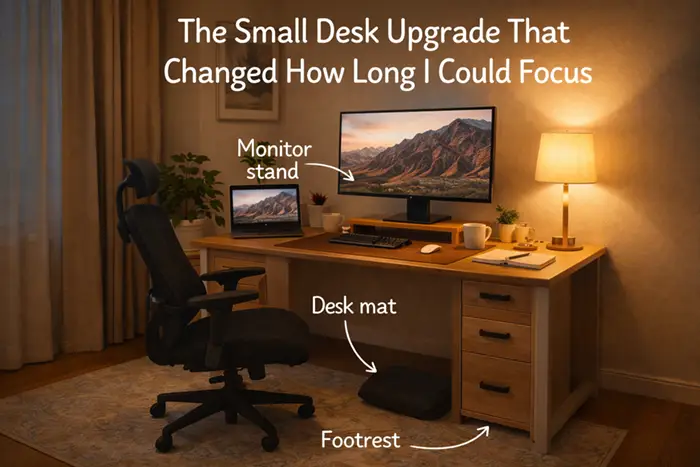
The Small Desk Upgrade That Changed How Long I Could Focus

For a long time, I thought my focus problem was mental. I’d sit down with good intentions, clear tasks, even a quiet room — and still feel restless after a short stretch. I blamed motivation, discipline, maybe even the work itself. It never occurred to me that my body was quietly asking for help the entire time.

The first thing I noticed was how often I shifted in my chair. Not dramatically — just small adjustments. Feet tucking back, legs crossing and uncrossing, shoulders creeping upward. None of it felt uncomfortable enough to fix, but all of it pulled my attention away in tiny increments. My focus wasn’t breaking all at once — it was leaking.

The change came from something almost embarrassingly simple: supporting my body better where it was already struggling. A footrest gave my legs a place to settle instead of hovering. A desk mat softened the space under my hands, reducing that subtle tension I didn’t realize I was holding. The desk didn’t look different — it just felt easier to stay in.

Once that friction was gone, time behaved differently. I wasn’t checking the clock as often. I wasn’t standing up just to reset myself. My thoughts stayed with the work longer because my body stopped asking for constant adjustments. Focus stopped feeling like effort and started feeling like a natural result of being comfortable.

What surprised me most was how quiet the improvement was. No productivity hacks. No timers. Just fewer physical interruptions pulling me out of the moment. The desk became a place I could stay, not escape from.

I didn’t expect something this simple to make my home feel calmer.


📦 Buy on Amazon USA

Under-desk footrest

Desk mat with soft surface

Low-profile monitor stand

Supportive ergonomic desk chair


🕯️ Final Thoughts

Focus isn’t always about willpower — often it’s about how much resistance your body is quietly pushing against. When your posture is unsupported or your setup asks for constant micro-adjustments, attention gets scattered before you even notice it happening.

What worked for me was addressing the physical layer first. Giving my body fewer reasons to interrupt the task at hand made mental clarity easier to reach and easier to keep. The work didn’t change — the experience of doing it did.

Sometimes the most effective desk upgrades aren’t the ones that promise performance, but the ones that make staying put feel natural. When your body settles, your mind often follows.


📦 Buy on Amazon Canada

Under-desk footrest

Desk mat with soft surface

Low-profile monitor stand

Supportive ergonomic desk chair

Bedroom & Comfort, Cozy Living

Why Some Rooms Feel Loud (Even When They’re Silent)

There was a time when my space felt oddly tense, even when nothing was happening. No TV on. No music playing. No conversations bouncing around. And yet, sitting there felt restless, like the room itself was buzzing. It took a while to realize that silence doesn’t always mean calm — sometimes it just means there’s nothing masking the noise the room is creating on its own.

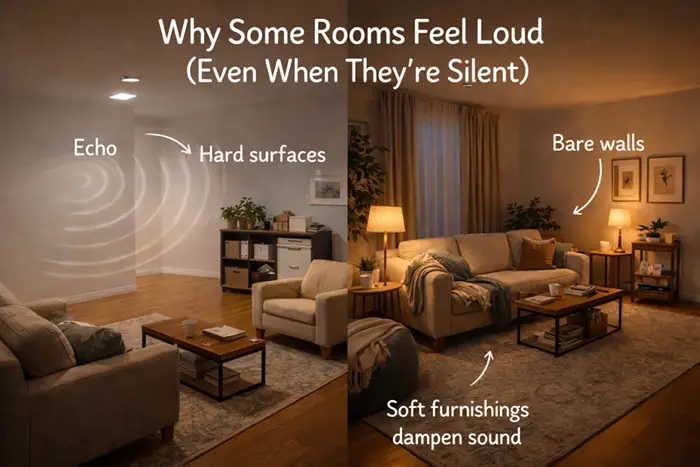
Hard surfaces were the biggest contributor. Bare floors, uncovered windows, smooth walls — everything reflected sound instead of absorbing it. Footsteps echoed longer than they needed to. The clink of a mug felt sharp. Even small movements carried more weight than expected. The room wasn’t noisy, but it was alert, constantly feeding sound back into itself.

Bare walls added to that feeling too. Without anything to interrupt them, sound had nowhere to land. Voices felt slightly harsher. Quiet moments felt exposed. The space didn’t soften what happened inside it — it amplified it. I noticed I was speaking more carefully, moving more cautiously, without really knowing why.

The shift came when I introduced softness, not for decoration, but for balance. A rug underfoot changed how the room responded immediately. Sound stopped bouncing and started settling. Curtains dulled the sharpness coming from the windows. Even fabric wall decor helped break up flat surfaces that had been acting like mirrors for sound.

What surprised me most was how quickly my body reacted. I felt less on edge without consciously relaxing. Sitting still felt easier. The room stopped reacting to every movement, and in doing so, it stopped asking for my attention.

I didn’t expect something this simple to make my home feel calmer.


📦 Buy on Amazon USA

Area rug with dense pile

Fabric or thermal curtains

Soft wall hangings or textile decor

Cushioned seating pads


🕯️ Final Thoughts

Sound shapes how a room feels just as much as light or layout. When everything reflects noise, even silence can feel sharp and unsettled. A space doesn’t have to be loud to be tiring — it just has to lack softness.

What worked for me wasn’t muting the room completely, but rounding off its edges. Letting sound fade instead of bounce. Allowing the space to absorb life rather than echo it back. Those small changes made the room feel more forgiving.

A calmer home often sounds quieter not because there’s less happening, but because the space knows how to hold it gently. When a room stops reacting to every sound, it finally feels like a place you can rest.


📦 Buy on Amazon Canada

Area rug with dense pile

Fabric or thermal curtains

Soft wall hangings or textile decor

Cushioned seating pads

Cozy Living, DIY & Decorating

I Stopped Rearranging Furniture — and Fixed the Room Instead

For a long time, I thought the solution to a room that felt “off” was to keep moving things around. Couch here. Chair there. Desk angled differently. Every few weeks I’d try again, convinced I just hadn’t found the right layout yet. But no matter how much I rearranged, the room still felt awkward — like it was working against me instead of with me.

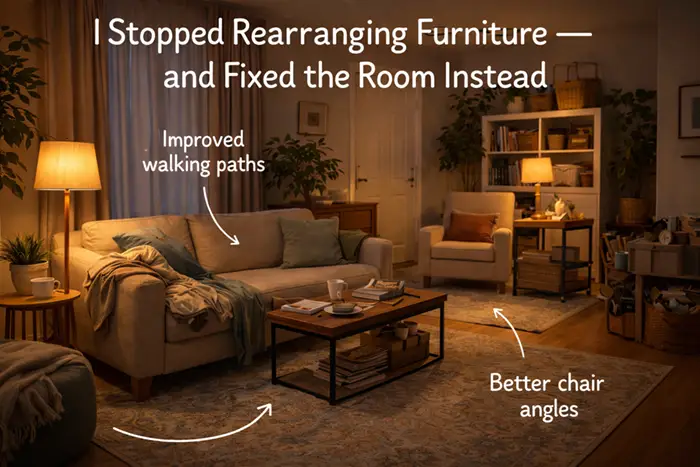
What finally clicked was that the problem wasn’t where things were placed, but how I was moving through them. Walking paths were tight in some spots and oddly wide in others. I was constantly stepping around furniture instead of flowing past it. Once I paid attention to how I entered the room, where I naturally walked, and where I paused, the issues became obvious.

Chair angles were another quiet culprit. A chair pointed slightly away from where I actually sit or look might not seem like a big deal, but it creates subtle resistance. I noticed myself never fully settling into certain spots — not because they were uncomfortable, but because they were misaligned. Rotating a chair just a few degrees toward the room changed how welcoming it felt, without moving it anywhere else.

Then there were the dead zones. Corners that collected nothing useful. Spaces between furniture that didn’t serve a purpose. These weren’t empty in a peaceful way — they were just forgotten. Instead of leaving them unresolved, I gave them small, intentional roles. A slim side table where I naturally reach. A rolling cart where clutter used to drift. Suddenly, those dead zones became helpful instead of distracting.

Rugs helped more than I expected too. Not as decoration, but as anchors. They defined where movement stopped and where rest began. A rug under a chair made it feel grounded. One under a table clarified its purpose. The room didn’t get fuller — it got clearer.

I didn’t expect something this simple to make my home feel calmer.


📦 Buy on Amazon USA

Low-profile area rug

Slim rolling storage cart

Compact side table

Under-desk floor mat


🕯️ Final Thoughts

A room doesn’t always need new furniture — it often needs better logic. When walking paths are clear and seating feels intentional, your body relaxes without you realizing why. You stop adjusting, sidestepping, and compensating.

What surprised me was how little I actually moved things. Most pieces stayed where they were. I just paid attention to how I lived in the space instead of how it looked on first glance. That shift made everything feel more cooperative.

Fixing a room doesn’t have to be loud or expensive. Sometimes it’s about noticing the friction, smoothing it out, and letting the space finally support the way you move through your day.


📦 Buy on Amazon Canada

Low-profile area rug

Slim rolling storage cart

Compact side table

Under-desk floor mat

Bedroom & Comfort, Cozy Living

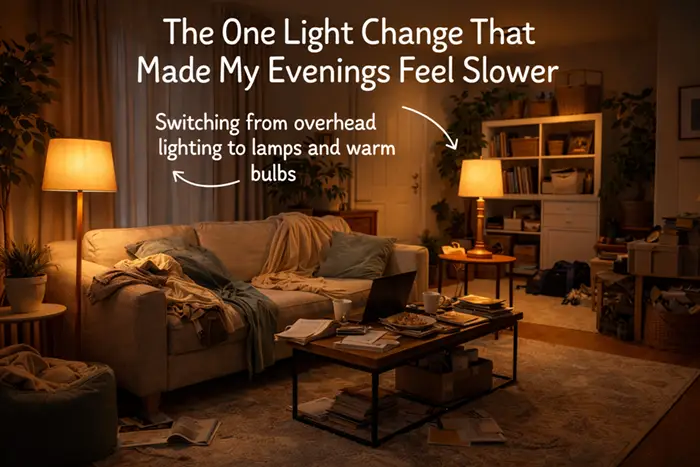
The One Light Change That Made My Evenings Feel Slower

For a long time, my evenings didn’t really feel like evenings. I’d finish what I needed to do, sit down, and still feel wired — like my body hadn’t gotten the message that the day was over. Nothing was wrong exactly. The apartment was fine. The routine was fine. But something about the space kept everything feeling alert instead of calm.

The biggest culprit turned out to be the overhead light. Bright, white, and centered — it lit the room efficiently, but it also flattened everything. Shadows were sharp, corners felt exposed, and the space stayed in “day mode” well into the night. Even when I was resting, my eyes and nervous system didn’t get a break.

Switching to lamps changed that almost immediately. Light coming from the side instead of above softened the room in a way I didn’t expect. Walls felt warmer. Depth came back. The room stopped feeling like a place to do things and started feeling like a place to be. It wasn’t dramatic — just noticeably easier on the senses.

Warm bulbs made an even bigger difference. That subtle shift from cool to warm light slowed everything down visually. Colors looked gentler. Evenings stretched instead of snapping shut. I found myself lingering a little longer with a book, or sitting quietly without feeling like I should be doing something else.

Placement mattered too. A lamp near where I sit, another tucked into a corner — not for brightness, but for balance. The room stopped feeling evenly lit and started feeling intentionally lit. That unevenness created pockets of calm, and somehow made time feel less rushed.

I didn’t expect something this simple to make my home feel calmer.


📦 Buy on Amazon USA

Warm-glow table lamp

Soft white LED bulbs (2700K)

Floor lamp with fabric shade

Plug-in dimmer switch


🕯️ Final Thoughts

Lighting sets the emotional tempo of a room more than we realize. Overhead lights are practical, but they’re rarely gentle. When they’re the only option, evenings can feel harsh and unfinished, even when everything else is in place.

What I appreciated most about this change was how subtle it was. No rewiring. No big purchases. Just choosing light that worked with the evening instead of against it. The space didn’t demand attention anymore — it allowed it to settle.

A calmer home doesn’t always come from adding more. Sometimes it comes from turning one thing off, and letting something softer take its place. When the light slows down, the rest of the night often follows.


📦 Buy on Amazon Canada

Warm-glow table lamp

Soft white LED bulbs (2700K)

Floor lamp with fabric shade

Plug-in dimmer switch

Bedroom & Comfort, Cozy Living

Why Your Home Feels Tiring — Even When You’re Doing Nothing

There was a stretch where I couldn’t figure out why I felt drained at home, even on days when I hadn’t done much at all. I wasn’t rushing, I wasn’t overwhelmed with tasks, and yet the space itself felt heavy. Sitting on the couch didn’t recharge me. Being at my desk didn’t feel grounding. It took a while to realize the problem wasn’t my energy — it was the environment quietly pulling from it.

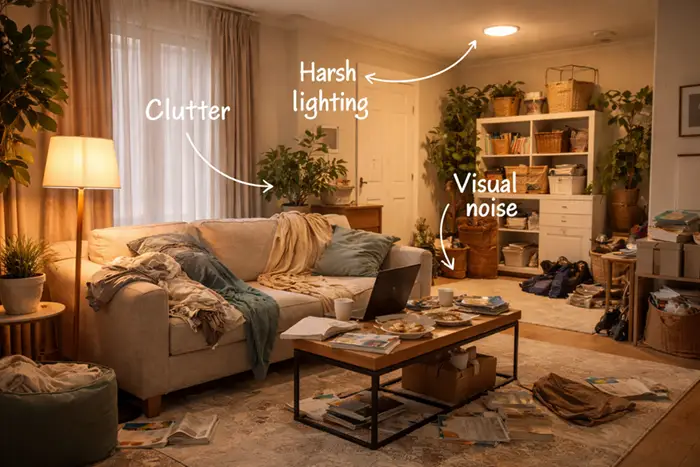
Visual noise plays a bigger role than we give it credit for. Open shelves packed with half-used items, cables that never quite disappear, stacks that don’t belong anywhere specific — none of it screams “stress,” but all of it whispers. Your eyes are constantly scanning, sorting, deciding. Even when you’re resting, your brain is still working, trying to make sense of the space around you.

Lighting was another piece I underestimated. Harsh overhead lights made evenings feel sterile and exposed, like the day never really ended. Shadows landed in odd places, corners felt unfinished, and nothing invited me to settle in. Once I started using softer, warmer light — lamps placed lower, light bouncing off walls instead of blasting straight down — the room instantly felt quieter. The same space, just easier to exist in.

Then there’s flow — how you move through a room without thinking about it. When furniture interrupts natural paths, when storage is inconvenient, when you have to sidestep or reach awkwardly just to live your life, it adds friction. Not enough to notice consciously, but enough to wear you down over time. When I adjusted a few placements and gave everyday items a real home, movement became automatic again.

Textures mattered more than I expected too. Hard surfaces everywhere reflected sound and light in ways that kept the room feeling alert instead of restful. Adding soft elements — curtains, fabric bins, a rug underfoot — absorbed some of that edge. The room didn’t change dramatically, but it stopped asking so much from me.

I didn’t expect something this simple to make my home feel calmer.


📦 Buy on Amazon USA

Soft-glow table lamp

Fabric storage bins with lids

Light-filtering curtains

Low-pile area rug


🕯️ Final Thoughts

A home doesn’t have to be messy to be exhausting. Sometimes it’s just visually loud, poorly lit, or slightly out of sync with how you actually live. Those small mismatches add up quietly, especially when you’re spending a lot of time indoors.

What surprised me most was how gentle the fixes were. No big renovations. No dramatic overhauls. Just small adjustments that reduced visual strain and made the space feel more cooperative, like it was finally on my side instead of asking me to manage it.

Comfort at home often comes from subtraction rather than addition. Fewer distractions, softer light, smoother flow. When a space stops demanding your attention, rest becomes possible again — even when you’re doing absolutely nothing.


📦 Buy on Amazon Canada

Soft-glow table lamp

Fabric storage bins with lids

Light-filtering curtains

Low-pile area rug

Cozy Living, DIY & Decorating

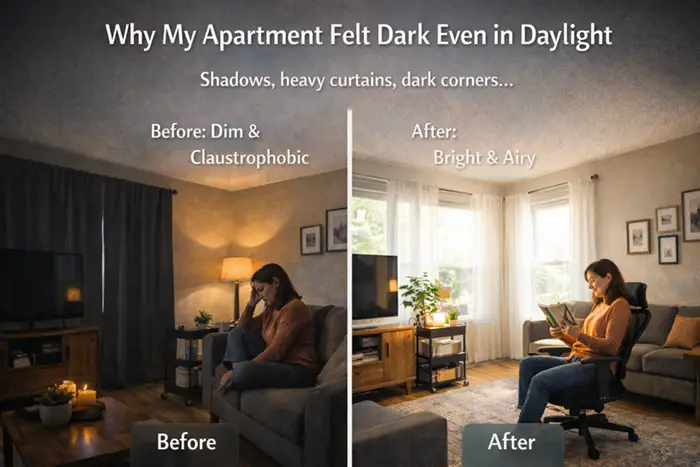
Why My Apartment Felt Dark Even in Daylight

For a long time, I couldn’t understand why my apartment felt dim even on bright days. Sunlight was coming in. The windows weren’t small. And yet, the space always felt a step removed from daylight — like the light stopped short of fully entering the room. I kept thinking something was wrong with the apartment itself, when really, it was how the light was being handled once it arrived.

Window direction was the first thing I started paying attention to. Light from the north or shaded sides of a building is softer and more indirect, which can be beautiful — but it also disappears faster inside. Without realizing it, I was treating that gentle light the same way I would treat strong, direct sun. The result was a room that never quite filled in.

The biggest culprit turned out to be the curtains. They weren’t heavy or dark, just thicker than they needed to be. Even when open, they absorbed more light than they passed along. The fabric softened the glow, but it also muted it. Daylight was entering the room, then quietly stopping at the window instead of spreading.

Wall color played a role too. Not in a dramatic way — just enough to matter. Darker or matte finishes don’t bounce light very far. They keep it close. I realized the light was pooling near the windows instead of traveling across the room. The space wasn’t dark — the light just didn’t have anywhere to go.

The shift came when I stopped thinking about adding light and started thinking about guiding it. I swapped in sheer curtains that let daylight pass through instead of filtering it away. I placed a mirror where it could catch light naturally instead of facing it straight on. I added a soft lamp in a corner that never quite brightened on its own. Nothing structural changed — but the room did.

What surprised me most was how much brighter the space felt without being harsher. Daylight stretched further. Corners softened. Even cloudy days felt usable instead of heavy. The apartment didn’t just look brighter — it felt more awake.


📦 Buy on Amazon USA

Sheer Curtains (Light-Filtering, Not Blocking)

Decorative Wall or Floor Mirror

Soft Ambient Table or Floor Lamp

Slim LED Light Panels for Dark Corners


🕯️ Final Thoughts

Light doesn’t just enter a home — it needs permission to move. When it’s blocked, absorbed, or stopped too early, even bright days can feel muted. The fix isn’t always stronger bulbs or bigger windows. Often, it’s simply removing obstacles the light was never meant to fight.

What I’ve learned is that brightness is about flow, not intensity. Letting daylight travel across a room changes how the space feels emotionally, not just visually. It brings a sense of openness that renovations can’t always replicate.

If your home feels dim even when the sun is out, look at what happens after the light comes in. A few thoughtful adjustments can help your space finally catch up to the day outside.


📦 Buy on Amazon Canada

Sheer Curtains (Light-Filtering, Not Blocking)

Decorative Wall or Floor Mirror

Soft Ambient Table or Floor Lamp

Slim LED Light Panels for Dark Corners

Bedroom & Comfort, Cozy Living

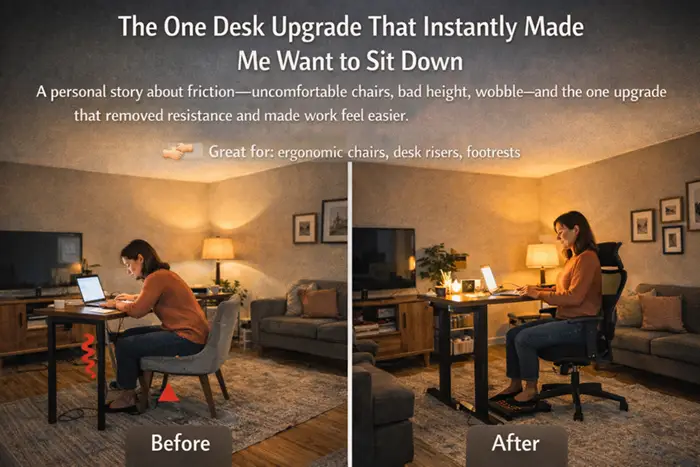
The One Desk Upgrade That Instantly Made Me Want to Sit Down

For a long time, I avoided my desk without realizing I was doing it. I’d find reasons to work from the couch, the kitchen table, anywhere else. On the surface, everything looked fine — decent desk, chair that technically worked, nothing broken. But sitting down always felt like effort. Like my body knew something wasn’t quite right before my brain caught up.

The friction showed up in small ways. The chair was a little too low. The desk a little too high. My feet never felt settled. There was a faint wobble when I leaned forward that made me tense without knowing why. None of it was dramatic — just enough resistance to make sitting down feel like a chore instead of an invitation.

What finally pushed me to change wasn’t productivity or posture goals. It was the realization that I was avoiding a space that was supposed to support me. That felt backwards. A desk shouldn’t require motivation to use — it should quietly remove obstacles.

The upgrade itself wasn’t flashy. I didn’t replace the desk or overhaul the room. I focused on one thing: how my body met the space the moment I sat down. The difference was immediate. The chair height finally matched the desk. My feet rested fully instead of hovering. The slight wobble disappeared. For the first time, sitting felt… neutral. And that neutrality turned into comfort faster than I expected.

I noticed it the same day. I sat down without hesitation. No shifting. No adjusting. No mental resistance. I stayed longer without forcing it. The desk stopped feeling like a task and started feeling like a place I could actually settle into.

🛋️ Human line:
I didn’t expect something this simple to make my home feel calmer.

What surprised me most was how much energy I’d been spending compensating before. When a chair is wrong or a desk height is off, your body is constantly micro-adjusting. Fixing that didn’t just improve comfort — it removed a quiet drain I didn’t know was there.


📦 Buy on Amazon USA

Ergonomic Desk Chair with Adjustable Height

Desk Riser (Sit-Stand or Height Adjustment)

Supportive Footrest for Under Desk


🕯️ Final Thoughts

Comfort at a desk isn’t about luxury — it’s about alignment. When your body fits the space without effort, your mind follows. Work feels lighter not because it’s easier, but because nothing is getting in the way anymore.

What I’ve learned is that resistance often hides in plain sight. A chair that’s almost right. A desk that’s close enough. Those small mismatches add up, quietly discouraging you from settling in.

If your desk feels fine but you keep avoiding it, trust that instinct. The right upgrade isn’t always more — sometimes it’s the one adjustment that finally lets your body relax into the space it’s already in.


📦 Buy on Amazon Canada

Ergonomic Desk Chair with Adjustable Height

Desk Riser (Sit-Stand or Height Adjustment)

Supportive Footrest for Under Desk

Cozy Living, DIY & Decorating

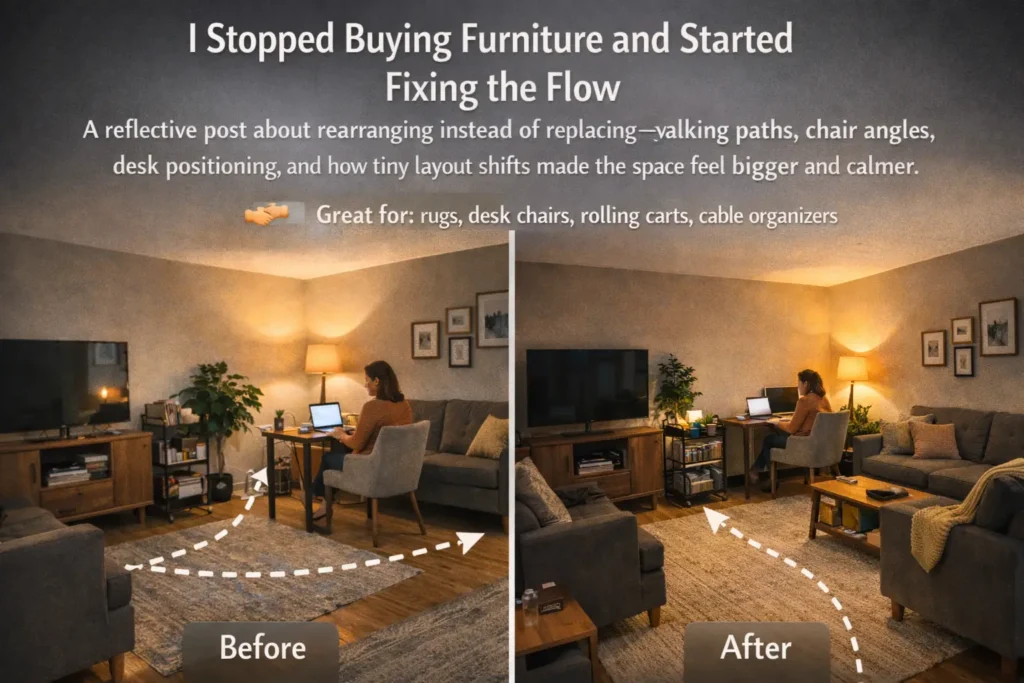
I Stopped Buying Furniture and Started Fixing the Flow

For a long time, my instinct was to replace things. If a room felt cramped or awkward, I assumed the solution was new furniture — a slimmer desk, a different chair, maybe another shelf. I’d browse, compare, imagine how much better the space would feel once something new arrived. But oddly enough, the room never felt calmer afterward. Just… rearranged chaos.

What finally changed things wasn’t buying anything at all. It was paying attention to how I actually moved through the space. Where I walked. Where I hesitated. Where I kept bumping into corners or shifting a chair just to pass through. The room wasn’t too small — it was just asking for a better conversation between the furniture and my body.

I started with walking paths. Clearing a few inches here, rotating a chair there. Turning the desk slightly instead of keeping it rigidly squared to the wall. Suddenly, the room stopped feeling like a collection of objects and started feeling like a place designed to move through. My steps felt smoother. My shoulders stopped twisting awkwardly just to get by.

Chair angles made a bigger difference than I expected. A chair facing directly into a wall feels confrontational somehow, like it’s demanding focus even when you’re tired. Angling it slightly opened the space visually and mentally. The same desk, the same chair — but the room felt less rigid, more forgiving.

I noticed it most during quiet moments. Sitting down with a coffee. Standing up to grab a notebook. Rolling my chair back without snagging on cables or rug edges. These weren’t dramatic changes, but they added up to something that felt… kinder. The room stopped interrupting me.

🛋️ Human line:
I didn’t expect something this simple to make my home feel calmer.

What surprised me most was how much space I gained without removing anything. By letting furniture breathe — even just a few inches — the room felt larger, lighter, and easier to exist in. Flow isn’t about minimalism. It’s about reducing friction, so your space supports you instead of constantly asking you to adjust.


📦 Buy on Amazon USA

Low-Profile Area Rug (Easy to Slide Chairs Over)

Ergonomic Desk Chair with Smooth Casters

Slim Rolling Storage Cart

Under-Desk Cable Organizer Tray


🕯️ Final Thoughts

What I’ve learned is that a calm space doesn’t come from owning better things — it comes from letting the things you already have work together. Flow is invisible when it’s right, but painfully obvious when it’s wrong. Fixing it doesn’t require a shopping cart full of upgrades.

Small layout shifts can give a room back its purpose. Clear paths reduce mental noise. Angled seating softens the atmosphere. Tucked-away cables remove visual clutter you didn’t realize was draining your attention.

If a room feels tight or stressful, pause before replacing anything. Walk it. Sit in it. Notice where your body hesitates. Sometimes the most meaningful upgrade is simply allowing your space to move with you.


📦 Buy on Amazon Canada

Low-Profile Area Rug (Easy to Slide Chairs Over)

Ergonomic Desk Chair with Smooth Casters

Slim Rolling Storage Cart

Under-Desk Cable Organizer Tray

Bedroom & Comfort, Cozy Living

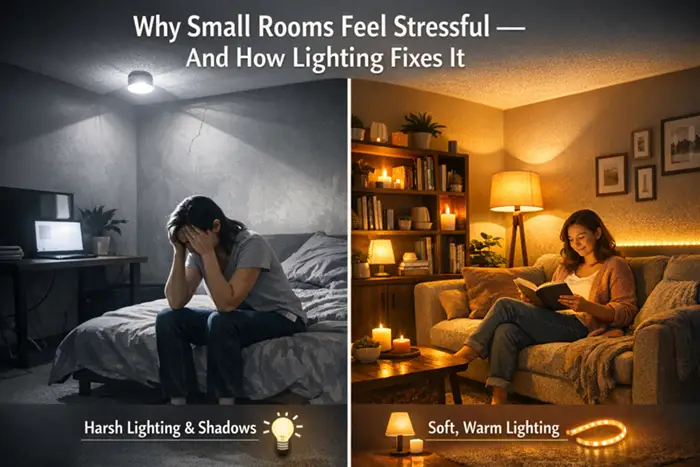
Why Small Rooms Feel Stressful — And How Lighting Fixes It

For a long time, I couldn’t quite explain why certain rooms made me feel tense the moment I walked in. Nothing was wrong exactly — the space was clean, organized, even minimal — but I always felt a little on edge, like my shoulders were permanently raised without me noticing. It took me longer than I’d like to admit to realize it wasn’t the size of the room doing this. It was the lighting.

Small rooms amplify everything. Shadows feel heavier. Harsh overhead lights bounce straight back into your eyes. Corners disappear into darkness while the center of the room feels exposed and flat at the same time. Your eyes are constantly adjusting, scanning, compensating — and your nervous system reads that as low-level stress. You don’t consciously think this room is overwhelming, but your body does.

I noticed it most in the evenings. The same room that felt tolerable during the day suddenly felt tight and restless once the sun went down. One ceiling light, one temperature, one direction — it left nowhere for my eyes to rest. The space felt smaller than it actually was, like it was pressing inward instead of opening up.

The shift happened slowly, almost accidentally. I added a small table lamp with a warm bulb, not even thinking much about it. Then another light near the floor. Later, a soft strip of indirect light behind a shelf. Nothing dramatic. But the room changed. Shadows softened. The walls felt farther away. My eyes stopped darting around, searching for balance. The space finally felt like it was holding me instead of demanding attention.

What surprised me most was how physical the change felt. My breathing slowed. My shoulders dropped. I started lingering in the room instead of passing through it. Lighting didn’t just change how the room looked — it changed how long I wanted to stay there, and how calm I felt while I did.

🛋️ Human line:
I didn’t expect something this simple to make my home feel calmer.

Good lighting in a small room isn’t about brightness — it’s about layers. Soft light at eye level, gentle glow near the floor, warm tones that tell your brain it’s safe to relax. When light comes from different directions, the room stops feeling boxed in. It gains depth, even if the square footage never changes.


📦 Buy on Amazon USA

Warm LED Table Lamp

Smart Warm-Tone Bulbs (2700K–3000K)

LED Light Strip for Indirect Lighting

Slim Floor Lamp with Soft Shade


🕯️ Final Thoughts

Small rooms don’t need to be fixed — they need to be understood. When a space feels stressful, it’s often because our senses are overloaded or under-supported. Lighting quietly shapes that experience, whether we realize it or not.

What I’ve learned is that comfort doesn’t come from making a room brighter, newer, or bigger. It comes from reducing visual tension. Soft light gives your eyes a place to land. Warm tones signal rest. Indirect glow creates breathing room where walls once felt close.

If a room in your home feels off and you can’t explain why, start with the light. You might be surprised how much calmer your space — and your body — feels when the room finally stops asking for your attention.


📦 Buy on Amazon Canada

Warm LED Table Lamp

Smart Warm-Tone Bulbs (2700K–3000K)

LED Light Strip for Indirect Lighting

Slim Floor Lamp with Soft Shade

Scroll to Top