Home Organization

Decluttering, storage and practical organization ideas for a calmer home.

Calm uncluttered room with clear surfaces and organized cables
Cozy Living, Home Organization

The Hidden Stress of Visual Clutter (And How to Fix It)

Disclosure: As an Amazon Associate, My Indoor Space may earn from qualifying purchases through links in this article, at no extra cost to you.
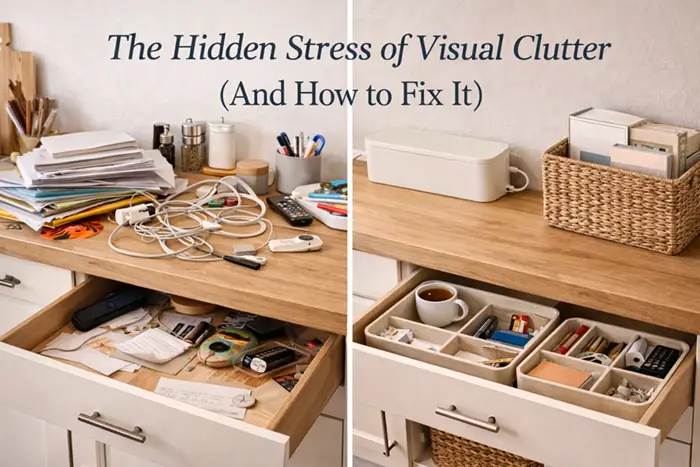
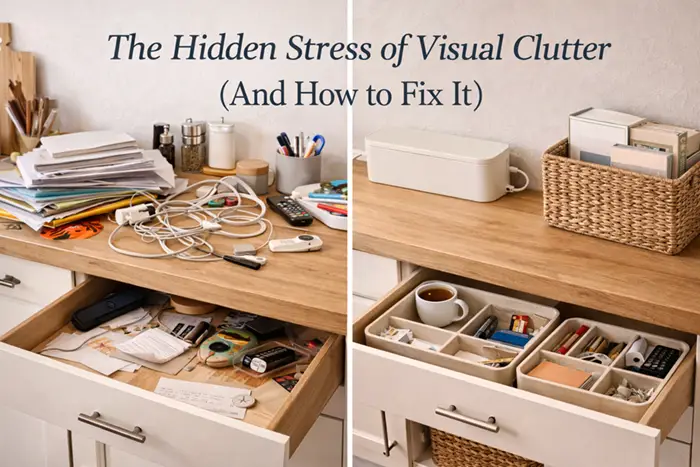
There’s a kind of clutter that doesn’t always seem serious at first. It’s not piles of garbage or a room that’s completely messy. It’s smaller things — cables sitting on a desk, a few random items on the kitchen counter, papers stacked in a corner that slowly grow over time. Individually they seem harmless, but together they quietly change how a room feels.

I started noticing that certain parts of my home felt slightly stressful even when nothing major was wrong. The counters weren’t dirty. The room wasn’t chaotic. But my eyes kept landing on small piles of things that didn’t quite belong anywhere. That subtle visual noise made the space feel more restless than it needed to be.

Visual clutter affects the brain in a way people don’t always realize. When objects compete for attention, your mind keeps processing them in the background. A stack of papers, tangled cables, or scattered accessories becomes something your brain keeps noticing over and over again. Even if you’re not consciously thinking about it, the space feels busier than it should.

One of the biggest culprits turned out to be cables. Charging cords and device wires tend to spread across desks and side tables without anyone noticing. Once I started using a simple cable box to gather them together, the difference was immediate. Suddenly the desk looked calmer because the wires weren’t constantly pulling your attention.

Drawer organizers helped in a similar way. Small items like pens, remotes, adapters, and tools often end up scattered around because they don’t have a defined place. Giving those objects a simple structure inside a drawer means they disappear from view but remain easy to find when you need them.

Storage bins also solved the issue of random items that move around the room during the day. A basket or bin doesn’t need to be complicated — it just gives wandering objects a home so they don’t end up creating new clutter piles on tables or countertops.

Even desktop trays can change the feel of a space. When a few everyday items sit neatly inside a tray instead of spreading across a surface, the whole desk suddenly looks intentional rather than messy. The room hasn’t changed much physically, but visually it feels more organized.

Once I started paying attention to these small details, the shift was noticeable. A clear surface and a defined home for loose items can make the next reset easier to repeat. But removing visual clutter quietly removes a lot of background stress that builds up during the day.

📦 Buy on Amazon USA

Cable Management Box for Desks and Charging Stations

Expandable Drawer Organizer for Home Storage

Fabric Storage Bins for Shelves and Closets

Minimalist Desktop Organizer Tray


🕯️ Final Thoughts

Clutter doesn’t always show up as a major mess. Often it’s the smaller things — loose objects, cables, or scattered items — that slowly create visual tension in a room. When too many things compete for attention, the space can feel busier than it really is.

What helps most is giving everyday objects a simple home. Cable boxes, organizers, and trays don’t remove the items you use — they just contain them so the room can breathe again.

Over time, these small changes make a home feel calmer and easier to live in. The space looks clearer, the mind feels quieter, and everyday routines start to feel a little smoother.

📦 Buy on Amazon Canada

Cable Management Box for Desks and Charging Stations

Expandable Drawer Organizer for Home Storage

Fabric Storage Bins for Shelves and Closets

Minimalist Desktop Organizer Tray

If visible cords add to the clutter, compare cable management boxes for a home office.
Cozy Living, Home Organization

The “Invisible Clutter” Reset

Disclosure: As an Amazon Associate, My Indoor Space may earn from qualifying purchases through links in this article, at no extra cost to you.

Your brain notices more than you think.

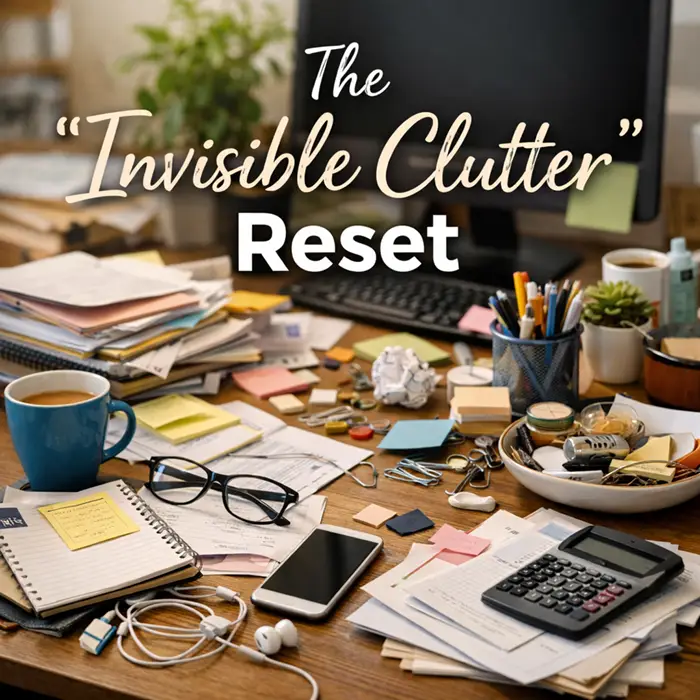
I didn’t realize how much visual noise was sitting in my space until I stopped trying to “clean” and just stood still for a minute. Not scrubbing. Not organizing. Just looking. And once I saw it, I couldn’t unsee it.

It wasn’t dirt. It wasn’t chaos. It was the small things my eyes kept tripping over — cords looping across the floor, storage bins that didn’t match, surfaces holding just one too many items, random paper piles that weren’t urgent but also weren’t gone. Nothing dramatic. Just constant low-level distraction.

Start with the cables, paper, or exposed storage that pulls your eye each time you enter the room.

When I started paying attention, I realized my brain was quietly cataloging all of it. Every visible cable. Every overloaded shelf. Every uneven stack of documents. It wasn’t stressful in a loud way. It was subtle — like background static. And once I removed a few of those friction points, the room didn’t just look better. It felt lighter.

The first thing I tackled was cords. Not all of them — just the obvious ones. A cable box to hide the power strip. A simple cord organizer under the desk. Suddenly the floor looked intentional instead of busy. My eyes stopped snagging on black wires against light walls.

Then I looked at storage. Mismatched bins aren’t wrong… but when they sit out in the open, they create visual tension. Swapping them for a matching set instantly made the room feel coordinated without adding anything new. Same amount of stuff. Different visual rhythm.

Paper piles were next. I didn’t throw everything away. I just gave the papers a defined home — a document tray that made them look purposeful instead of forgotten. That small shift changed how the entire surface felt.

This reset isn’t about deep cleaning. It’s about removing the small visual interruptions your brain keeps processing in the background.

And once they’re gone, you notice something surprising:

Silence.

Not literal silence — visual silence. Your eyes move smoothly through the room instead of hopping from distraction to distraction. The space feels finished. Settled.

A clear spot for daily papers and a safe place for cords make the reset easier to keep.


📦 Buy on Amazon USA

Cable Management Box

Under-Desk Cord Organizer Tray

Matching Storage Baskets (Set)

Document Paper Tray Organizer


🕯️ Final Thoughts

Invisible clutter is sneaky. It doesn’t shout at you the way a messy kitchen does. It just lingers — quietly tugging at your attention every time you walk past. And over time, that small tug adds up.

What surprised me most wasn’t how the room looked after the reset — it was how it felt. Calmer. More finished. Less restless. My brain wasn’t working as hard.

You don’t need a renovation. You don’t need new furniture. Sometimes all you need is to remove the tiny visual speed bumps your eyes keep hitting. That’s the reset.


For a contained place to hide a power strip, use the cable management box guide to check size and ventilation.

📦 Buy on Amazon Canada

Cable Management Box

Under-Desk Cord Organizer Tray

Matching Storage Baskets (Set)

Document Paper Tray Organizer

Cozy Living, Home Organization

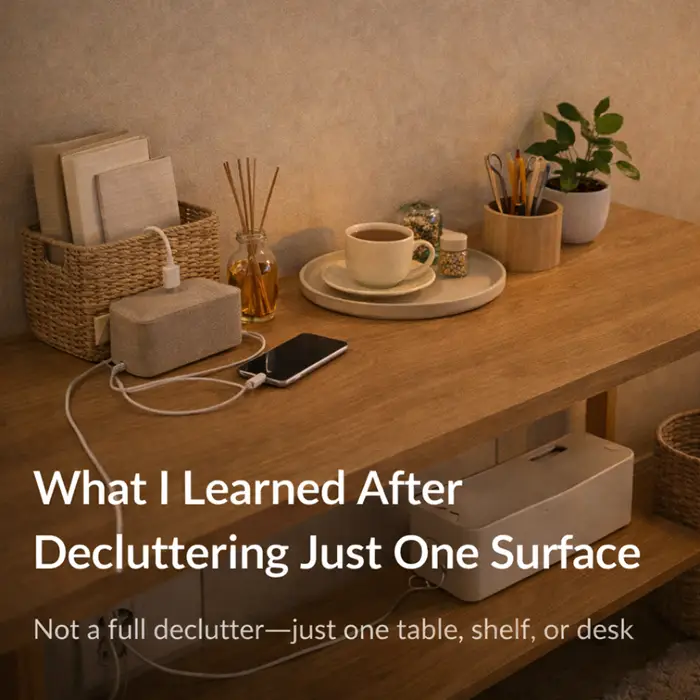
What I Learned After Decluttering Just One Surface

Disclosure: As an Amazon Associate, My Indoor Space may earn from qualifying purchases through links in this article, at no extra cost to you.

I didn’t overhaul my home. I didn’t pull everything out of closets or commit to some dramatic, all-day purge. I just cleared one surface.

It was a table that had quietly become a landing strip for everything — mail, keys, cables, receipts, things I meant to deal with later. Nothing chaotic, nothing embarrassing. Just enough visual noise that my eyes never really got to rest when they passed over it. I didn’t realize how often I was registering that clutter until it was gone.

The first thing I noticed after clearing it wasn’t pride. It was stillness. The room felt wider. Not physically larger, but calmer — like it could breathe again. One clean surface created a small pocket of order that rippled outward. I found myself setting things down more intentionally instead of dropping them and moving on.

What surprised me most was how little I actually needed to remove. A tray for the daily essentials. A simple basket for loose items that didn’t belong out in the open. A small cable box to tuck away the mess of cords that had been pretending not to exist. The difference wasn’t about minimalism. It was about containment.

I also noticed how that one cleared space changed how I moved through the room. I didn’t avoid glancing at it anymore. I didn’t feel a quiet reminder of “I should deal with that.” The surface stopped asking something from me. It just existed peacefully.

🛋️ I didn’t expect clearing one surface to shift the feel of the whole room.

📦 Buy on Amazon USA

Decorative tray

Storage baskets

Drawer organizers

Cable management box

🕯️ Final Thoughts

Decluttering doesn’t always need to be dramatic to be meaningful. One clear surface can act like a reset button for your eyes and your mind. It’s a small gesture that quietly lowers the volume in a room.

What I appreciated most was how sustainable it felt. I didn’t create a new system I had to maintain perfectly. I just gave everyday items a contained place to live. That alone reduced friction.

Sometimes calm doesn’t come from clearing everything. It comes from choosing one place, finishing it, and letting that finished feeling anchor the rest of the space.

If small items move from the table to a drawer, see organizers for deep kitchen drawers before buying.

📦 Buy on Amazon Canada

Decorative tray

Storage baskets

Drawer organizers

Cable management box

Cozy Living, Home Organization

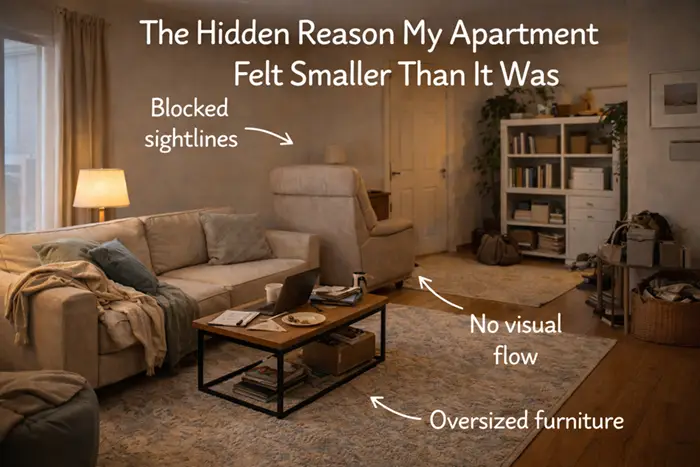
The Hidden Reason My Apartment Felt Smaller Than It Was

Disclosure: As an Amazon Associate, My Indoor Space may earn from qualifying purchases through links in this article, at no extra cost to you.

For a long time, I was convinced my apartment was just small. I’d walk in and feel slightly boxed in, even though nothing was technically wrong. The square footage hadn’t changed. The furniture fit. And yet the space felt tighter than it should have, like it was closing in instead of opening up.

What I eventually noticed was how quickly my eyes ran into obstacles. Tall shelves cut sightlines in half. Furniture sat directly in the path of doorways. Even when there was enough room to walk, the space looked interrupted. My eyes couldn’t travel far before hitting a visual wall, and that made the room feel shorter and narrower than it really was.

Oversized furniture played a bigger role than I realized too. A deep couch, a bulky chair, storage pieces that hugged the floor — they all anchored the room visually, but in a heavy way. They pulled attention downward and inward. Even when the room was tidy, it felt dense, like everything was fighting for the same slice of space.

The shift came when I focused on visual flow instead of layout. Lower-profile furniture opened up sightlines instantly. Slim shelving let the eye move through instead of stopping it. Wall hooks lifted everyday items off the floor, clearing visual clutter without removing function. The room didn’t lose anything — it gained breathing room.

Once those blocks were gone, the apartment started feeling more expansive without actually getting bigger. Light traveled farther. Corners felt reachable again. Even movement felt easier, like the space was cooperating instead of resisting.

Furniture scale and clear routes often matter more than the apartment’s square footage.


📦 Buy on Amazon USA

Slim wall-mounted shelving

Minimal wall hooks

Narrow storage cabinet

Low-profile furniture risers


🕯️ Final Thoughts

A space can feel small even when it isn’t — especially when sightlines are broken and furniture overwhelms the eye. What tires us isn’t the size itself, but how quickly the room asks us to stop looking.

What worked for me wasn’t removing everything, but choosing pieces that allowed the space to flow visually. When the eye can move freely, the body relaxes. The room feels less compressed, even if nothing structural changes.

Sometimes the most spacious feeling comes from clearing what blocks the view, not adding more room. When a space finally opens up visually, it becomes easier to live in — and easier to rest inside.


If storage is part of the problem, the renter-friendly closet organizer guide covers space-saving options.

📦 Buy on Amazon Canada

Slim wall-mounted shelving

Minimal wall hooks

Narrow storage cabinet

Low-profile furniture risers

Cozy Living, Home Organization

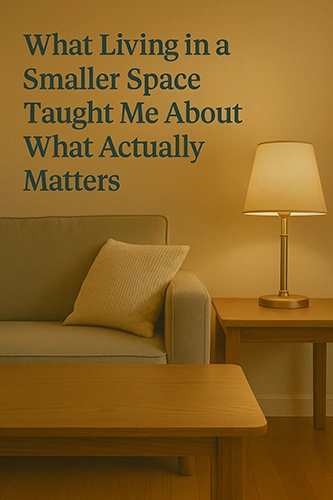
What Living in a Smaller Space Taught Me About What Actually Matters

Disclosure: As an Amazon Associate, My Indoor Space may earn from qualifying purchases through links in this article, at no extra cost to you.

Living in a smaller space quietly changes the way you see everything. At first, it feels like limitation. Less room. Fewer options. Nowhere to hide things you’re not ready to deal with. Every object is closer, more visible, more present. I didn’t choose a smaller space to learn a lesson — but it taught me one anyway.

When space is limited, what you keep starts to matter more. Not because of aesthetics, but because of impact. Every piece of furniture affects how you move. Every item you own affects how the room feels. There’s no room for excess without consequence. I started noticing how quickly clutter affected my mood, how even small piles could make the space feel heavy and unsettled.

What surprised me was how much I didn’t miss. Once the extras were gone, the space felt calmer instead of emptier. I moved more easily. I rested more fully. I stopped feeling like I needed to constantly adjust or improve things. The home began working with me instead of asking something from me all the time.

Living smaller also made me more intentional. I paid attention to light, warmth, and flow instead of filling corners. Comfort came from alignment, not accumulation. A chair in the right place mattered more than having more seating. A clear surface mattered more than decorative storage. The space became quieter, and in that quiet, I felt more present.

Over time, that presence extended beyond the home. I became less interested in buying things to solve feelings. I learned to adjust, remove, and simplify first. The smaller space trained me to notice what actually improved my day and what just took up room — physically and mentally.

Now, I see my home less as a container for stuff and more as a support system. Living smaller didn’t reduce my life. It refined it. It taught me that what matters most isn’t how much space you have, but how gently that space holds you.

🪑 Living smaller didn’t take anything away — it showed me what was already enough.


📦 Buy on Amazon USA

🪑 Compact Multi-Purpose Furniture

🕯️ Warm Ambient Table Lamps

📦 Slim Storage Bins for Small Spaces


🕯️ Final Thoughts

A smaller space makes priorities visible. When there’s less room to distract yourself, you start noticing what truly supports your comfort and peace. The home becomes honest — it reflects your habits, your needs, and your values without exaggeration.

There’s freedom in realizing that enough doesn’t require abundance. When your space is aligned with how you live, it stops demanding attention and starts offering support. Calm becomes easier to maintain because there’s less competing for it.

If you’re living in a smaller space — or feeling overwhelmed in a larger one — consider what the space is teaching you. What you keep, what you remove, and what you choose to live with every day quietly shapes how life feels. Sometimes smaller isn’t restrictive at all. Sometimes it’s clarifying.


For storage that works in a smaller home, see the renter-friendly closet organizer guide.

📦 Buy on Amazon Canada

🪑 Compact Multi-Purpose Furniture

🕯️ Warm Ambient Table Lamps

📦 Slim Storage Bins for Small Spaces

Cozy Living, Home Organization

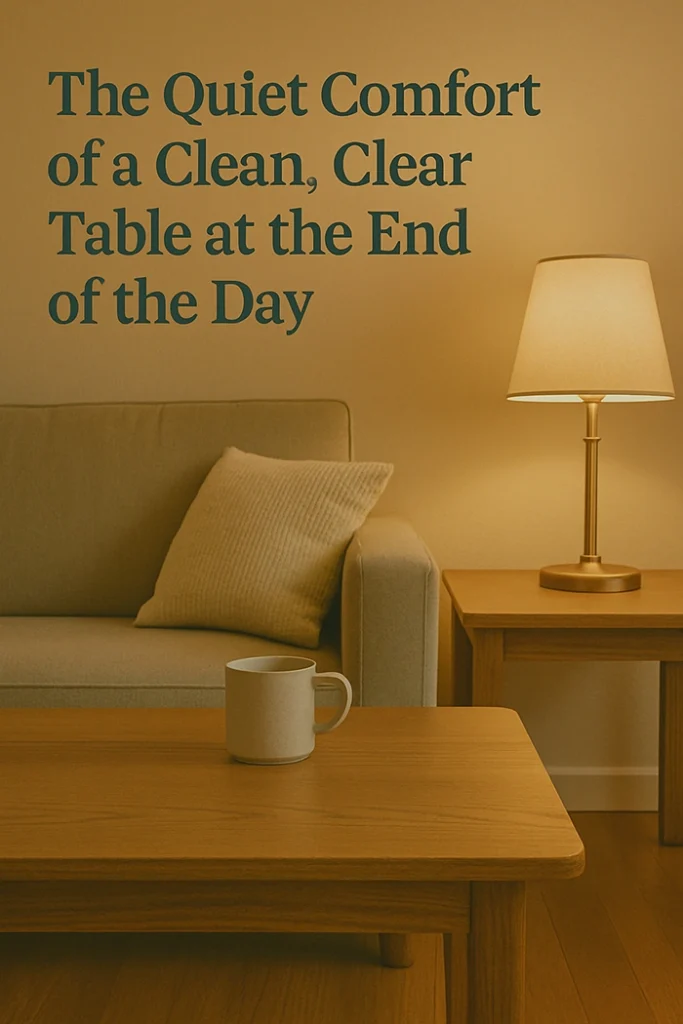
The Quiet Comfort of a Clean, Clear Table at the End of the Day

Disclosure: As an Amazon Associate, My Indoor Space may earn from qualifying purchases through links in this article, at no extra cost to you.

There’s something deeply reassuring about walking into a room at night and seeing a table that’s been cleared. No stacks waiting to be dealt with. No half-finished tasks frozen in place. Just a clean, open surface that isn’t asking anything of you. I didn’t realize how much that mattered until I started doing it consistently.

For a long time, my table doubled as everything — workspace, drop zone, reminder board. It wasn’t chaotic, but it was never truly at rest. Even in the evening, when the day was technically over, the table still held traces of it. Papers, small objects, things I meant to put away later. I’d sit down to relax and still feel slightly on edge, like the day hadn’t fully ended.

Clearing the table became a small nightly habit almost by accident. Before winding down, I’d put things back where they belonged or stack them neatly out of sight. Not a deep clean — just enough to reset the surface. The first night I did it, the room felt different immediately. Quieter. Softer. The table stopped holding the weight of the day.

What surprised me most was how emotional the shift felt. A clear table wasn’t about neatness — it was about closure. It signaled that nothing was left unfinished right now. Tomorrow could handle tomorrow. Tonight was allowed to be empty. That empty space felt comforting instead of wasteful.

Over time, that habit started affecting how I moved through the evening. I relaxed faster. I slept better. The room felt more forgiving. The table became a place of rest instead of responsibility. And that small visual calm carried more weight than I ever expected.

Now, even on busy days, I try to end the night with a clear table. It’s a quiet way of telling myself the day is done. Nothing dramatic. Nothing performative. Just a small, intentional pause that makes the space — and my mind — feel lighter.

🪑 A clear table doesn’t mean the day was perfect — it just means it’s allowed to be over.


📦 Buy on Amazon USA

đź§ş Decorative Storage Baskets (Neutral Tones)

đź§˝ Microfiber Cleaning Cloths

🪵 Minimalist Table Tray Organizer


🕯️ Final Thoughts

Calm often arrives after we remove what no longer needs our attention. A clean, clear table creates a sense of completion that words rarely do. It doesn’t celebrate productivity — it honors rest.

There’s comfort in knowing that your space isn’t holding onto anything for you overnight. When surfaces are cleared, your mind follows. The room stops reminding you of what you didn’t finish and starts supporting the quiet moments you need instead.

If evenings still feel unsettled, try ending the day with one intentional reset. Clear one table. Let the space exhale. Sometimes that’s all it takes to feel at ease again.


If table items need a home in nearby storage, the deep-drawer organizer guide offers sizing tips.

📦 Buy on Amazon Canada

đź§ş Decorative Storage Baskets (Neutral Tones)

đź§˝ Microfiber Cleaning Cloths

🪵 Minimalist Table Tray Organizer

Cozy Living, Home Organization

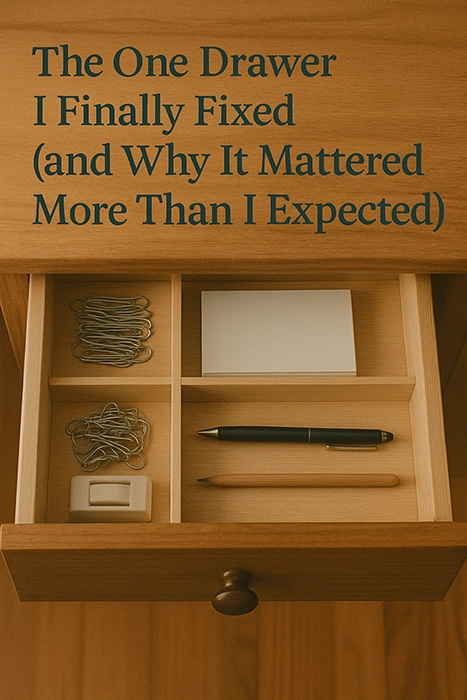
The One Drawer I Finally Fixed (and Why It Mattered More Than I Expected)

Disclosure: As an Amazon Associate, My Indoor Space may earn from qualifying purchases through links in this article, at no extra cost to you.

For months, there was one drawer I avoided opening unless I absolutely had to. It wasn’t disastrous — nothing spilling out, nothing broken — just a mess of small things that never stayed where I put them. Cables tangled with random tools, loose papers mixed with things I “might need later.” Every time I opened it, I felt a flicker of irritation, then closed it again and moved on.

What finally pushed me wasn’t motivation or a free afternoon. It was noticing how often that drawer quietly annoyed me. Each time I opened it, my shoulders tightened just a bit. I’d dig around longer than necessary, then leave it slightly worse than before. One evening, without planning to “organize,” I emptied it onto the table and decided to fix just that one space — nothing else.

I didn’t aim for perfection. I grouped things that belonged together and removed what clearly didn’t. I added simple dividers, gave everything a rough home, and stopped when it felt clear enough. The whole thing took less than half an hour. When I slid the drawer back in, it felt finished in a way the rest of the room suddenly didn’t.

The real surprise came later. The next time I opened the drawer, there was no resistance. No small spike of frustration. I found what I needed immediately and closed it again without thinking. That moment felt oddly satisfying — not because the drawer was organized, but because it was no longer asking anything from me.

Fixing that one drawer didn’t change how my home looked, but it changed how it felt to move through it. It removed a tiny but constant source of friction. And once I noticed that relief, I understood why small, focused organization can matter more than big cleanups. One resolved space can carry more mental weight than an entire room that’s “mostly fine.”

Now, whenever I feel overwhelmed by clutter, I think smaller. One drawer. One shelf. One place that keeps quietly bothering me. That single fix often does more for my sense of calm than tackling everything at once ever did.

🗂️ I didn’t fix the drawer to be organized — I fixed it so it would stop asking for my attention.


📦 Buy on Amazon USA

🗂️ Adjustable Drawer Dividers

📦 Small Clear Storage Trays

đź§ş Non-Slip Drawer Organizer Liners


🕯️ Final Thoughts

Organization doesn’t always need momentum — sometimes it just needs focus. Fixing one small, specific problem can deliver more relief than spreading your energy across an entire space. That drawer mattered because it removed friction I’d been carrying without realizing it.

There’s something grounding about resolving a single annoyance completely. It restores a sense of control without demanding a full reset. When one space works the way it should, it quietly improves everything around it.

If clutter feels overwhelming right now, try going smaller than you think you should. One drawer, fully handled, can change how your home feels far more than a half-finished overhaul ever will.


For the drawer dividers discussed here, see the deep-drawer organizer guide before measuring.

📦 Buy on Amazon Canada

🗂️ Adjustable Drawer Dividers

📦 Small Clear Storage Trays

đź§ş Non-Slip Drawer Organizer Liners

Cozy Living, Home Organization

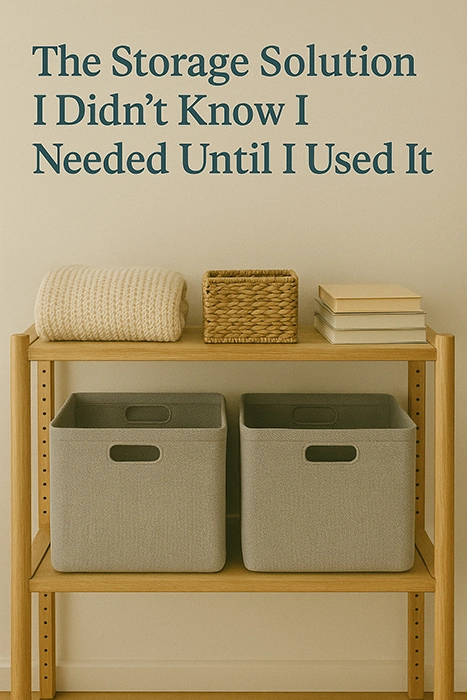
The Storage Solution I Didn’t Know I Needed Until I Used It

Disclosure: As an Amazon Associate, My Indoor Space may earn from qualifying purchases through links in this article, at no extra cost to you.

I didn’t think storage was my problem. My place wasn’t cluttered, and nothing felt out of control. Still, there was a low-level irritation I couldn’t quite explain. Small items never stayed where I expected them to. I’d move them from one surface to another without really noticing, always telling myself I’d deal with it later. It wasn’t chaos — just constant friction that never fully went away.

The change came when I added one simple storage solution without much planning. Nothing flashy. Nothing clever. It fit where it needed to fit, and that was enough. I placed a few everyday items inside — the ones that always seemed to float around — and went on with my day. I didn’t think much of it until later, when I realized the room felt different.

What surprised me was how quickly that difference showed up. The space felt calmer. Not cleaner in a dramatic way — calmer. My eyes stopped catching on loose objects. I stopped adjusting things every time I walked past. The room no longer felt unfinished or mildly irritating in the background.

The reason it worked was simple: it matched how I already lived. I didn’t have to remember a new system or force new habits. Items I used often were easy to reach. Things I didn’t need every day finally had a proper home. The storage didn’t add effort — it removed it.

Only afterward did I realize how much mental energy had been tied up in unfinished organization. Once those items had somewhere to go, that background noise disappeared. The room stopped asking for attention. And without trying, the entire space felt more comfortable and settled.

🗂️ I didn’t add storage to feel organized — I added it so my space could finally relax.


📦 Buy on Amazon USA

📦 Clear Stackable Storage Boxes

đź§ş Fabric Storage Bins (Neutral Colors)

🗂️ Slim Drawer Organizers


🕯️ Final Thoughts

The best storage solutions don’t stand out. They quietly support your routines and then fade into the background. When storage works the way it should, you stop thinking about it — and that’s exactly the point.

A calmer home usually comes from removing small points of friction rather than making big changes. Giving everyday items a place that actually makes sense can shift how an entire room feels, even if nothing else changes.

If your space feels slightly unsettled but you can’t explain why, look for the things that never seem to land anywhere. The right storage solution won’t impress you — it will simply make your home feel better once it’s there.


For items stored out of sight, compare bins and fit in the under-bed storage guide.

📦 Buy on Amazon Canada

📦 Clear Stackable Storage Boxes

đź§ş Fabric Storage Bins (Neutral Colours)

🗂️ Slim Drawer Organizers

Cozy Living, Home Organization

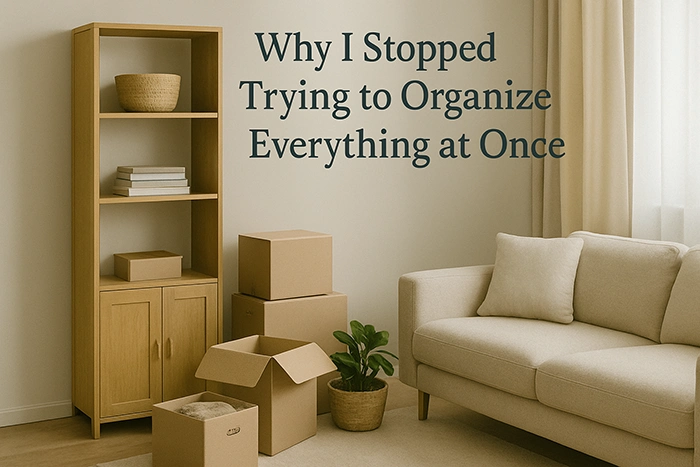
Why I Stopped Trying to Organize Everything at Once

Disclosure: As an Amazon Associate, My Indoor Space may earn from qualifying purchases through links in this article, at no extra cost to you.

For a long time, I approached organization the same way I approached stress — all or nothing. If I was going to get my home under control, I felt like I had to do everything at once. Every room. Every drawer. Every pile I’d been avoiding. I’d build it up in my head as a big reset, something dramatic that would finally make the space feel calm again. And almost every time, the idea alone was exhausting enough to stop me before I started.

What I didn’t realize then was how much pressure that mindset was creating. Looking at my home as one giant problem made it feel heavier than it actually was. Even when I had the time, I didn’t have the mental energy. I’d stand in the middle of a room, unsure where to begin, already discouraged by how much there was to do. Organization stopped being helpful and started feeling like another expectation I couldn’t meet.

The shift happened quietly. One afternoon, instead of planning a full overhaul, I picked a single room — not the worst one, not the most visible, just the one I happened to be in. I didn’t aim to finish it. I didn’t even aim to make it perfect. I chose one small area and worked until it felt lighter. When I stopped, something unexpected happened: I felt relief instead of guilt.

Working room by room changed everything. Each space became its own small project instead of part of an overwhelming whole. I started noticing progress again — real progress, not imagined perfection. A calmer corner here. A cleared surface there. Each completed area gave me permission to stop without feeling like I’d failed. The mental load lifted because the goal was no longer total control, just steady improvement.

What surprised me most was how much better the space felt before everything was finished. Living with one organized room at a time allowed the calm to arrive gradually. I could feel the difference immediately instead of waiting for some future moment when everything was done. The house didn’t need to be perfect to feel better — it just needed to be more intentional than it was yesterday.

Now, I don’t try to organize my entire home anymore. I listen to where the friction is and address it slowly. One room. One drawer. One shelf. That approach has made the process sustainable instead of stressful. Organization stopped being about control and became about care — and that’s a change that finally stuck.

🛋️ Letting myself organize slowly didn’t make me less productive — it made the relief arrive sooner.


📦 Buy on Amazon USA

🗂️ Simple Storage Bins (Neutral Colors)

đź§ş Fabric Drawer Organizers

📦 Clear Stackable Storage Boxes


🕯️ Final Thoughts

Trying to organize everything at once often delays the very calm we’re searching for. When the goal becomes too big, the effort feels too heavy. Slowing down allows progress to feel achievable again, and that sense of completion — even in small doses — matters more than we realize.

A home doesn’t need to be fully organized to feel supportive. It needs pockets of ease, places where your attention can rest instead of scanning for what’s unfinished. Each room you gently improve becomes proof that change doesn’t have to be dramatic to be meaningful.

If organization has felt overwhelming lately, consider giving yourself permission to move slower. Start where you are. Finish what feels manageable. Calm has a way of showing up the moment you stop trying to force it.


To give seasonal items one contained home, use the under-bed storage guide for sizing.

📦 Buy on Amazon Canada

🗂️ Simple Storage Bins (Neutral Colors)

đź§ş Fabric Drawer Organizers

📦 Clear Stackable Storage Boxes

Scroll to Top