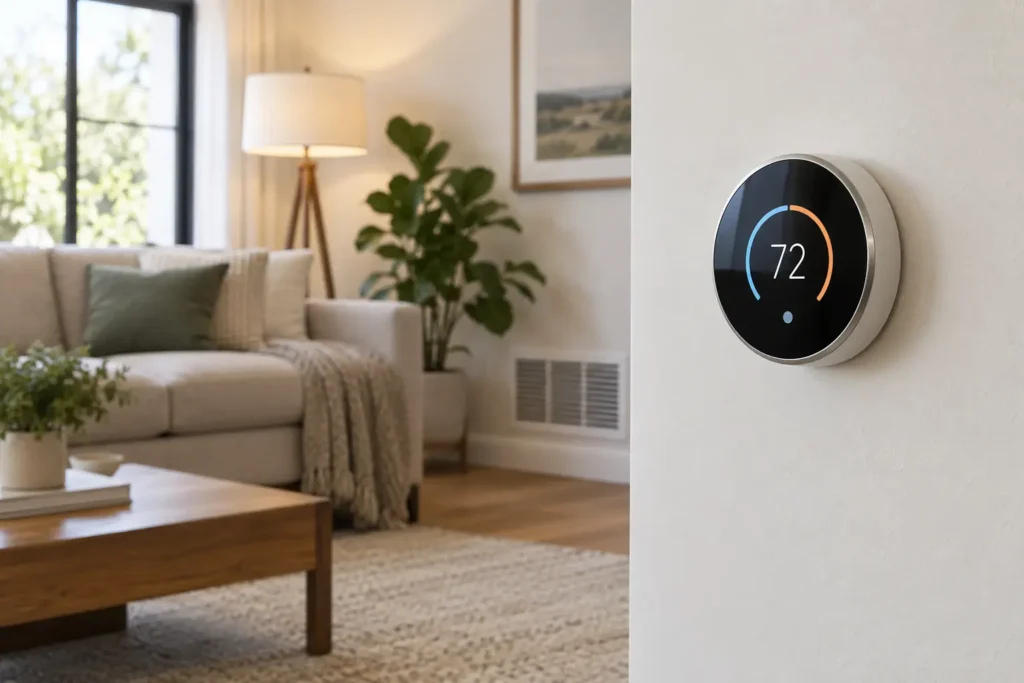
Will a Smart Thermostat Work in My Home?
Disclosure: This post contains affiliate links. If you buy through one of our links, we may earn a commission at no extra cost to you. Thermostat wiring controls heating and cooling equipment; when system type, voltage, or wiring is uncertain, use a qualified HVAC or electrical professional.
A smart thermostat can add scheduling, remote control, energy reports, and convenient temperature adjustments. But compatibility is not as simple as matching wire colors. Before buying, you need to identify the HVAC equipment, control voltage, number of heating and cooling stages, available wires, and whether the existing thermostat uses proprietary communication.
This guide walks through those checks without asking you to guess. The safest rule is simple: use the prospective thermostat manufacturer’s current compatibility checker with your exact equipment and wiring, then confirm any ambiguous result with a professional.
Quick verdict
Most popular smart thermostats are designed for conventional low-voltage 24-volt HVAC systems, including many furnaces, central air conditioners, boilers, and heat pumps. Compatibility becomes less certain with electric baseboard heating, high-voltage thermostats, proprietary communicating systems, multi-stage equipment, millivolt heaters, and heat pumps with auxiliary or emergency heat.
A C-wire is common and often preferred because it supplies continuous power, but some models can work without one or include an approved power accessory. Never assume an unused wire is connected at the HVAC control board.
Compatibility checklist
| Check | What you need to know | Why it matters |
|---|---|---|
| System type | Furnace, boiler, heat pump, central AC, baseboard, fan coil | Thermostats support different equipment families. |
| Control voltage | Low voltage, line voltage, or millivolt | Using the wrong thermostat can damage equipment or create a hazard. |
| Stages | Single-stage, two-stage, variable, auxiliary heat | The thermostat needs enough compatible terminals and logic. |
| Wire terminals | Letters on the old thermostat base | Terminal labels are more useful than wire colors. |
| Power | C-wire, supported power extender, or approved alternative | Smart features need reliable continuous power. |
| Communication | Standard on/off terminals or proprietary data bus | Communicating systems may require their matching controller. |
| Network | Supported Wi-Fi band and phone platform | Remote features depend on network and app compatibility. |
Step 1: identify the system, not just the thermostat
Find the model numbers on the indoor and outdoor HVAC equipment, then check the manuals or manufacturer documentation. A home may have a gas furnace with central air, an air-source heat pump with electric auxiliary heat, a boiler with radiators, or separate systems for different zones. Two thermostats in the same home may control entirely different equipment.
If you rent or live in a condo, ask the property manager or building maintenance team before changing controls. Shared fan-coil systems, building automation, and landlord-owned equipment may not accept a retail smart thermostat.
Step 2: distinguish low voltage from line voltage
Many central HVAC thermostats use small-gauge low-voltage wires and terminals labeled with letters such as R, C, W, Y, and G. Electric baseboard and some wall heaters often use a line-voltage thermostat with thicker wires and wire connectors inside an electrical box.
Do not remove or probe a thermostat if you are unsure of the voltage. Turn off the correct power source before any inspection directed by the manufacturer. A typical low-voltage smart thermostat must never be connected to a line-voltage circuit. Use a thermostat specifically rated for your heating voltage and load, or hire a qualified professional.
Step 3: photograph terminal labels before disconnecting anything
If the manufacturer’s instructions say it is safe to remove the faceplate, take a clear photo of the existing wiring while every wire is still connected. Record the terminal letters printed on the base. Wire colors are conventions, not proof of function; an installer may have used a different color or repurposed a conductor.
Look for labels such as:
- R, Rc, Rh: power from the HVAC transformer
- C: common return used for continuous thermostat power
- W or W1/W2: heating calls or stages
- Y or Y1/Y2: compressor or cooling stages
- G: indoor fan
- O/B: heat-pump reversing valve
- AUX or E: auxiliary or emergency heat
These are common conventions, not a universal wiring plan. Follow the equipment and thermostat documentation for your exact system.
Do you need a C-wire?
Smart thermostats need power for the display, Wi-Fi radio, sensors, and processor. A dedicated C-wire usually provides the most straightforward power path. If a wire is connected to C at the old thermostat, that is a good sign—but still verify the complete system against the compatibility tool.
If there is no C-wire, possible solutions include:
- Using an extra conductor already in the wall cable and connecting it correctly at both ends
- Installing the manufacturer’s approved power-extender or C-wire adapter
- Running a new thermostat cable
- Selecting a model explicitly compatible with your system without a C-wire
“Power stealing” designs draw small amounts of current through control circuits. Whether that works reliably depends on the thermostat and equipment. Symptoms of a poor match can include reboots, Wi-Fi dropouts, relay chatter, unexpected cycling, or depleted batteries. Do not improvise with an unapproved transformer or jumper.
Heat-pump compatibility needs extra attention
A heat pump can have a reversing valve, one or more compressor stages, and auxiliary or emergency heat. The thermostat must support the exact configuration and be set up correctly. A mistake can trigger expensive backup heat too often, run the system inefficiently, or prevent proper heating and cooling.
ENERGY STAR notes that certified smart thermostats may work with common systems, but equipment compatibility still varies—particularly for variable-speed and specialized heat-pump setups. Review the current guidance and certified products at ENERGY STAR, then use the thermostat maker’s system checker.
What about variable-speed and communicating HVAC?
Some premium HVAC systems use proprietary digital communication between the thermostat and equipment. Instead of several conventional call wires, the control may exchange detailed operating data over a small number of terminals. Replacing it with a conventional smart thermostat may remove modulation, diagnostics, humidity control, or efficiency features—even if an adapter is possible.
If the current controller has unusual terminal labels, a brand-specific interface, or advanced equipment menus, contact the HVAC manufacturer or an authorized technician before purchasing.
Zoned systems, boilers, and accessories
Zoned HVAC
The thermostat may connect to a zone-control panel rather than directly to the furnace or air handler. Compatibility depends on the panel, transformer capacity, dampers, and number of zones. Check each zone separately.
Boilers and hydronic heat
Many low-voltage boiler systems can work with smart thermostats, but millivolt controls, zone valves, circulators, and multiple transformers complicate the picture. A C-wire may not be present at the wall.
Humidifiers, dehumidifiers, and ventilators
Only some smart thermostats directly control whole-home accessories. Count the accessory terminals and verify supported wiring. A thermostat that handles temperature perfectly may still require separate controls for humidity or ventilation.
Smart features worth comparing
- Flexible scheduling: useful if your routine is predictable.
- Remote room sensors: can prioritize occupied rooms or average temperatures.
- Heat-pump controls: important for auxiliary heat thresholds and balance settings.
- Local controls: the thermostat should remain usable when internet service is down.
- Energy reports: helpful when they explain runtime and schedule changes clearly.
- Geofencing and occupancy: useful only if every household member’s privacy and routine fit the feature.
- Smart-home integration: verify your preferred platform and region before buying.
Privacy and long-term support
A connected thermostat can collect temperature, occupancy, equipment runtime, location-related, and account data. Read the current privacy policy, learn which features require cloud service, enable multi-factor authentication when available, and use a unique password.
Also look beyond the purchase date. Check the maker’s software-support record, whether basic scheduling works without a subscription, how account deletion works, and whether the thermostat retains essential manual control if a cloud service changes.
DIY installation or professional help?
A straightforward low-voltage, single-stage replacement may be within reach for an experienced homeowner who follows the product and HVAC instructions precisely. Professional installation is the better choice when:
- Voltage is uncertain or the existing thermostat controls electric baseboard heat
- There are multiple transformers, jumpers, splices, or unlabeled wires
- The system is communicating, variable-speed, dual-fuel, or multi-stage
- A heat pump uses auxiliary or emergency heat
- A new cable or control-board connection is required
- The equipment is under warranty and installation terms matter
- You simply do not feel confident identifying the circuit
Before-you-buy workflow
- Record indoor and outdoor equipment model numbers.
- Identify the existing thermostat make and model.
- Turn off power as directed before inspecting any wiring.
- Photograph terminal labels and connected wires.
- Run the exact information through the prospective manufacturer’s compatibility checker.
- Confirm C-wire or approved power-accessory requirements.
- Check Wi-Fi, phone, voice-assistant, and regional service compatibility.
- Review rebates only after confirming the exact eligible model and installation rules.
- Hire a qualified professional if any result is ambiguous.
Frequently asked questions
Can any smart thermostat replace any old thermostat?
No. Voltage, HVAC type, stages, power, accessories, and communication method all have to match.
Can I tell what a wire does by its color?
No. Use the labeled terminal where the wire is connected and the equipment documentation. Colors are helpful clues, not definitive identification.
Will a smart thermostat work without Wi-Fi?
Most retain basic local temperature control, but remote access, weather data, reports, and some automations may stop. Confirm offline behavior for the exact model.
Can a smart thermostat control electric baseboard heaters?
Only a model specifically rated for that line-voltage application and electrical load. Standard 24-volt smart thermostats are generally not direct replacements.
Will a smart thermostat lower my energy bill?
It can help by making schedules and setbacks easier, but savings depend on climate, equipment, insulation, household behavior, and the settings you use. Compatibility and correct configuration come first.
Shop smart thermostats
Do not order until you have run your HVAC and wiring information through the exact model’s current compatibility checker. Then compare support for stages, heat pumps, sensors, privacy controls, and approved power accessories.
Shop Amazon USA
Shop Amazon Canada
Final answer
A smart thermostat will likely work if your home has a compatible 24-volt conventional HVAC system, the model supports every heating and cooling stage, and it has an approved power solution. But do not buy from wire colors or a C-wire check alone. Confirm the equipment type, voltage, terminals, stages, and manufacturer compatibility result. For line-voltage, communicating, dual-fuel, variable-speed, or uncertain systems, get professional confirmation first.
After setup, pair a sensible schedule with the comfort-first ideas in My Home Feels Warmer—and It Has Nothing to Do with the Thermostat.